


Revival of a long-gone dress code
A team is trying to bring the traditional attire of the Han ethnic group into the mainstream







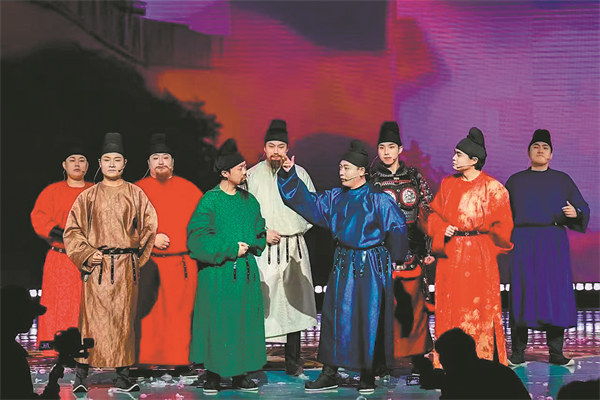
In the heart of Xi'an, capital of Shaanxi province, Wu Junqiang, a 25-year-old artistic director at the Hanfu Research Institute of Xi'an Polytechnic University, is at the forefront of a cultural revival. The institute's mission is to breathe life into hanfu, the traditional attire of the Han ethnic group.
"Hanfu is more than just clothing. It represents a lifestyle and a symbol of our cultural heritage," Wu said.
The institute in Xi'an is focusing on conducting a detailed study and recreating these garments from the past.
Established in 2023, the institute leverages the university's strengths in textiles, clothing and art design to focus on the dressing style during the Han (206 BC-220 AD) and Tang (618-907) dynasties and restore those traditions.
"Han dynasty clothing is elegant and dignified, and popular among international audiences. Tang Dynasty attire is inclusive, suitable for all body types, and offers a great experience. If you visit places such as Xianyang and Lintong in Shaanxi, Qin Dynasty (221-206 BC) clothing will be more appropriate,"Wu said.
One of the most iconic costumes the team created is inspired by female figurines from the Shaanxi Tang Tricolor Pottery Art Museum. Using the figurine art as a foundation, Wu and his team developed color schemes and restored a Tang Dynasty chest-high ruqun, a traditional Chinese garment consisting of a short top and a long wraparound skirt.
One of the most difficult tasks in their reconstruction process was getting the color right. They consulted numerous ancient texts because modern colors differ in brightness and combination from those used during the Tang Dynasty. They researched everyday items from the dynasty to understand their color sources.
"Traditionally, colors were extracted from the natural world. We got the pigments from flowers and plants, so our garments feature colors that are akin to those used during the Tang Dynasty," Wu said.
Wang Yiting, the designer in the team, said the use of natural dyes is a process that requires patience and skill.
"Natural dyes come from plants like gardenia and mulberry. Sometimes, we collect fresh leaves, steam them, and use them for dyeing. For rust dyeing, I've experimented by soaking rusty nails in vinegar for a month before using the solution to dye the fabric," she said.
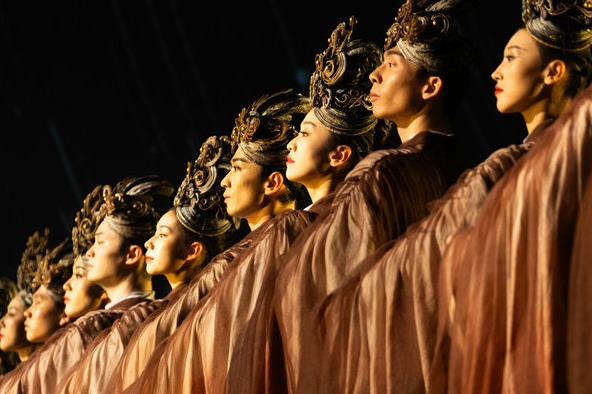
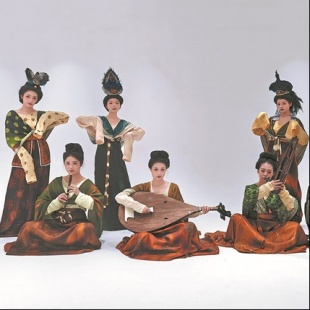
Another representative piece of art the team created is a replica of the Tang Dynasty tricolor music and dance figurines set, consisting of clothing worn by eight female figurines of musicians and dancers.
The dancers wore bird crowns, originally crafted from the feathers of various rare but now protected animals.
For the restoration, capturing rare birds was not feasible, Wu said. So they used feathers from domestically raised birds with visually appealing feathers, such as peacocks. Dyeing these feathers to get the specific colors of the endangered species, they created four bird crowns.
Before designing their clothing, they sought inspiration from historical sources, carefully studying the patterns found in ancient murals and figurines.