Companies to boost overseas investment
Updated: 2011-04-28 09:06
By Lan Lan (China Daily)
|
|||||||||||


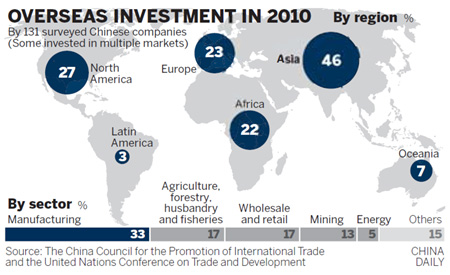
Survey: Sharp rise in firms planning more spending in foreign markets
BEIJING - Almost 90 percent of domestic companies involved in international trade plan to increase overseas investment, a survey reveals.
Of the 1,024 companies surveyed, about 88 percent said they want to boost investment overseas over the next two to five years, a sharp rise from a year earlier when 61 percent of the firms surveyed said they planned to expand investment.


China's foreign exchange reserves, the world's largest, hit $3.04 trillion at the end of March.
Li Xiaojing, head of the Bank of China's financial market department, said overseas investment will help diversify some of the reserves.
Asia, Europe and North America will be prime destinations for investment and Africa is gaining increasing importance as 22 percent of the companies surveyed had already invested there.
However, overseas investment remains small with about two-thirds of the companies surveyed investing less than $5 million in 2010. Only 8 percent made investments of more than $100 million.
In the next two to five years, about 30 percent of the companies surveyed expect to invest more than $5 million.
The central bank in January allowed the yuan to be used in direct overseas investments. Asia and South America will be potential markets, at least in the initial period, Li told China Daily.
But Jia Huai, the survey's project director, said he believed many companies still lacked the technical knowledge to take advantage of the yuan policy but it was a step in the right direction.
Sun Lujun, director of the capital management department of the State Administration of Foreign Exchange, said on Wednesday that the new policy will facilitate overseas investment and better support companies seeking markets overseas.
Sun also said China will continue to loosen restrictions on capital control and facilitate overseas investment by the end of 2015.
In addition to traditional investment models, such as building plants or upgrading existing facilities, a growing number of companies are looking at mergers and acquisitions.
Chinese investment overseas through mergers and acquisitions in 2010 was worth $23.8 billion, accounting for 40 percent of total investment.
Last year saw a new wave of companies targeting overseas acquisitions, including the high-profile private automaker Zhejiang Geely Holding Group buying Volvo Cars and Sinopec Group acquiring a stake in Repsol's Brazilian subsidiary.
Companies investing overseas traditionally favored the machinery and textile sectors, but recently investments in agriculture, mining and energy have surged, the survey said.
Other sectors are also attracting interest, an analyst said.
"High-tech and clean energy technology companies are becoming hot targets for overseas mergers and acquisitions," said Xu Weiqing, an analyst with Zero2IPO Group, a capital market research company.
In 2010, Chinese firms invested in 3,125 overseas companies in 129 countries and regions and total foreign direct investment in non-financial sectors rose 36 percent to $59 billion, according to the Ministry of Commerce.
China has become the world's second-largest acquirer of foreign companies, only next to the United States, according to a recent research by the Chinese Academy of Social Sciences.
But a lack of diversified fundraising channels also restricts investment overseas, the survey showed.
"Fundraising difficulties and lack of international operation experience are major limitations for Chinese companies hoping to expand overseas, especially for small- and medium-sized enterprises," said survey project director Jia.
Using the companies' own capital and borrowing from banks are the two main channels for overseas investment. Other financing channels such as stocks, securities and other market instruments are not widely used, Jia said.
- Govt promotes commercial insurance plans
- Shipbuilders to ride wave
- Solar firms ready to defend against US probe
- Favorable FDI policy essential
- New bank bosses announced
- Firms face dropping exports to Europe: Survey
- Farm produce prices up after dropping for 6 weeks
- Govt tries to soothe companies' concerns