Comments
  Print
Print  Mail
Mail  Large Medium Small
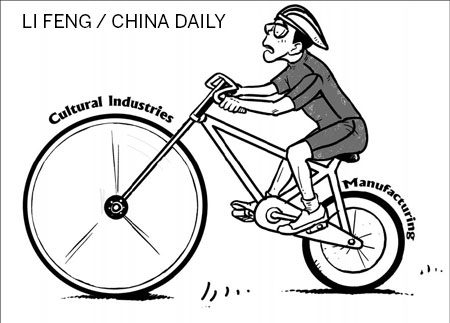
Prolonged economic difficulties in what are essentially Chinese manufacturers' main export markets pose long-term challenges to the country's economic model and this is placing an increasingly strong emphasis on the development of its cultural industries.
Cultural industries pioneer Li Wuwei, a Shanghai economist, estimates in How Creativity is Changing China (written in 2009 and translated into English last year) how little Chinese factories receive for making high quality goods for western brands, less than 10 percent of the retail price of the goods in Western markets.
And with rising inflation in China leading to higher pay demands from workers, the profit margin for Chinese manufacturers is becoming ever tighter. In the face of competition from less-developed nations, China can no longer rely on its low-cost manufacturing.
In contrast, Li reports that China's cultural industries grew significantly over the 2006-2009 period, with statistics from the China Industrial Design Association recording an average business net profit in excess of 30 percent in 2009.
In addition, in the process of relocating most of its manufacturing production to countries like China, the West has outsourced many of the negative consequences of these industries, most noticeably pollution. The creative industries directly produce value without needing to consume large amounts of material resources and this has influenced China's policy at the highest level.
Another reason for China's desire to grow its cultural industries is more socio-political in nature, and is tied to long-term structural changes within Chinese society. In the past five years there has been a rapid increase in the number of students with an academic interest in the cultural industries and these students want jobs that reflect their creative aspirations.
How can the Chinese government further develop these industries? Although the commercialization of the cultural industries brings with it the growth of related industries, as witnessed by the Shanghai municipal government's inclusion of consultancy and exhibition services on its official list of creative industries, neither commercialization nor broadening will necessarily produce the creativity that China needs.
Similarly, the development of clusters in cities has had mixed results, with many empty units beyond the more commercially successful spaces like Tianzifang in Shanghai and 798 in Beijing. Even in these successful ventures there is a sense in which the main beneficiaries have been the retail outlets rather than the creative workers.
The goal of the Chinese government should be to develop creative individuals rather than creative clusters, as the experience of other countries shows that clusters which develop organically, such as Greenwich Village in New York, are the most successful in encouraging creativity.
The key is to develop a creative society rather than a series of discrete policies. And good place to start would be in education, where further expansion of subjects that encourage student autonomy in learning, mainly but not exclusively associated with the arts and humanities, will encourage more creative thinking. Additionally, innovation in teaching methods should be encouraged so the students are able to express themselves even when what they say contradicts their teachers. More cultural industries programs need to be developed as well, such as those already available in institutions like Peking University.
Paradoxically, one of China's greatest success stories in the cultural industries highlights the challenges those industries face. Beijing-based animation company Crystal not only produced all the 3-D images for the spectacular opening of the 2008 Olympics, it has also been given the contract for digital imaging services for this year's London Olympics.
Its success is an important part of China's projection of soft power. But most of the estimated 120,000 minutes of animation that is produced each year in China is for Japanese or Korean companies. So, even in the cultural industries, much content is made in China rather than created in China. The Ministry of Culture is aware of this problem and the inclusion for the first time of a national plan for the cultural industries in the 12th Five-Year Plan (2011-15) is to be welcomed.
The success of Crystal has demonstrated that China's cultural industries can compete on the global stage, and it is to be hoped that institutional and social changes will make it the rule rather than the exception.
The author is an associate professor of creative industries and digital media at the University of Nottingham, Ningbo, China.
 Top 5 expected highlights at CES Asia 2016
 Purr-fect store: Read books as cats nap on your lap
 Young golfers enjoy the rub of the green
 Mushroom cultivation bases established in Ningxia
 Shanghai Disneyland starts soft opening on Saturday
 Teapot craftsman makes innovation, passes down techniques
 Top 8 iOS apps recommend for Mothers
 Japanese animator Miyazaki's shop a big hit in Shanghai

Copyright 1995 - . All rights reserved. The content (including but not limited to text, photo, multimedia information, etc) published in this site belongs to China Daily Information Co (CDIC). Without written authorization from CDIC, such content shall not be republished or used in any form. Note: Browsers with 1024*768 or higher resolution are suggested for this site.
License for publishing multimedia online 0108263 Registration Number: 20100000002731