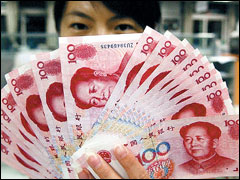
 Analysts are becoming skeptical a stronger yuan would ease U.S. trade
problems.
Analysts are becoming skeptical a stronger yuan would ease U.S. trade
problems.
As expectations build that the Chinese government will take
further steps to allow the yuan to appreciate, analysts are becoming
increasingly skeptical a stronger yuan would ease U.S. trade problems.
In fact, a sharp appreciation of the yuan, as some U.S. politicians are
calling for, may spell trouble for the U.S. and world economies.
The issue could come to a head next week during Chinese President Hu Jintao's
visit to the United States. Some U.S. politicians say an undervalued yuan (also
known as the renminbi) is the main factor behind the large trade deficit with
China.
"It's a fiction to think a 10% revaluation of the yuan would have any
measurable impact on U.S.-China trade," said David Gilmore, a partner at Foreign
Exchange Analytics.
The lower cost of labor and material in Chinese products compared with
American ones means that a 10% revaluation would still leave the balance in
favor of Chinese exports.
A faster-than-needed appreciation could cause the prices of many goods made
in China to go up, creating inflationary pressures for the U.S. and world
economy, while at the same time reducing China's willingness to finance the
swelling U.S. deficits, analysts cautioned.
"If they revalue by more than 5 to 7% ... it would be nearly disastrous for
the U.S. and world economy," said Ashraf Laidi, chief currency analyst at MG
Financial Group.
Token move
Still, most experts are expecting some move in the yuan this month. Laidi is
expecting at least a token gesture that could take the form of widening the
dollar/yuan band to a range such as 0.6% from its current 0.3%.
Such a pre-emptive measure might ward off criticism from the Bush
administration during Hu's trip April 18 to 22 and might help ensure China is
not named as a currency manipulator in the Treasury's upcoming report to
Congress, said Kathy Lien, chief fundamental analyst at Forex Capital Markets.
China revalued the yuan by 2.1% last July and hypothetically allows the
yuan to move as much as 0.3% daily against a basket of currencies. Since the big
move in July, the yuan has gained only 1.35% against the dollar, greatly
frustrating U.S. politicians who argue the Chinese currency remains undervalued
by as much as 40%.
The yuan has risen at an accelerated pace against the dollar recently, amid
heightened pressure from the U.S. It posted a new post-revaluation high of
8.0022 on Monday, one step closer to the psychologically key level of 8 yuan per
dollar.
Marc Chandler, global head of currency strategy at Brown Brothers Harriman,
said a gradual widening of the hypothetical trading band would be a low-cost
compromise for China.
"Remember under Bretton Woods, a 1% band was regarded as fixed. And even that
0.3% band is not being fully explored," Chandler said, referring to policies
implemented after World War II to manage the world economy.
Policy "misguided"
The more important question remains of whether a rise of the yuan against the
dollar would eliminate the U.S. trade deficit with China. That gap grew 24% in
2005 to $201.6 billion, more than a quarter of the total trade gap, according to
government data.
The conventional wisdom is a stronger yuan will encourage Chinese consumers
to purchase more American-made goods while at the same time making Chinese goods
more expensive to U.S. consumers, therefore narrowing the trade imbalances
between the two countries.
"The U.S. policy is misguided by focusing on the renminbi exchange rate,"
said BBH's Chandler, adding that policy makers should focus on such "bigger and
more important issues" as enhancing intellectual property rights and boosting
Chinese workers' wages.
Ronald McKinnon, an economics professor at Stanford University, agreed and
said U.S. policy is "misplaced."
"Today's American mercantile pressure on China to appreciate the renminbi
against the dollar is eerily similar to the American pressure on Japan to
appreciate the yen that began over 30 years ago," said McKinnon.
Indeed, succumbing to pressure from the U.S., the yen
went all the way down from 360 against the U.S. dollar in August 1971 to touch
80 on the dollar in April 1995.
(For more biz stories, please visit Industry Updates)