Media unfair on China's SEZ policies
By You Nuo (China Daily)Updated: 2007-03-26 14:47
Was the concept of the special economic zone (SEZ) a Chinese one? As reflected in international media coverage of India's recent peasant protests, one gets the impression that it was a Chinese invention.
Yet here in China, as a journalist who covered the Chinese economic reform from the 1980s, I can say that back then, Chinese economists talked about the SEZ as an imported concept, with India having made a few earlier attempts.
But there is even bigger confusion in the world media's coverage of the two countries' economic changes.
Whenever social discontent is reported in China, such as what the authorities call "collective actions", it is presented as signaling some major political crisis. When it takes place in India, it is sometimes brushed aside as just a lack of consensus.
Those killed in West Bengal not long ago were identified as peasants. They were the same people as Chinese peasants. Peasants don't usually choose to act violently. If they are driven to violence, there must be something very wrong.
The biggest wrong, I think, is not how the media chose to interpret events here and there but the entire amount of information available worldwide on the very concept of development. Whether dealing with the Chinese success or other nations' difficulties and failures, events are often mispresented in such a way as to distort the true experience.
For instance, the Chinese approach to development and building SEZs is sometimes characterized as government's cavalier uprooting from the land as many as 40 million peasants, a figure Western columnists like to use.
Even worse, as a British newspaper not long ago quoted some Indian economists as suggesting, China can change more quickly only because it can sack its workers in massive numbers, something forbidden by India's labor laws.
These are distortions of both the true picture in China and the very logic of development. Such heavy-handed actions would only lead to the kind of disaster that would wipe out every government in the world.
Although China has admittedly had problems in land use and labor relations,
the central government has been reasonably cautious and effective in
compensation and relocation programs. 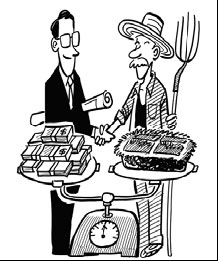
In the beginning decade of reform in the 1980s, there were only four SEZs in all of China unlike the reported dozens now waiting for approval in India.
When the number of Chinese SEZs began to multiply, the number of social dislocations increased. But the government eventually managed to compensate landless peasants and to place most of them in factory jobs.
If not, just think of the sheer size of 40 million people, enough to hold simultaneous sit-ins in Beijing, Shanghai, Guangzhou and Shenzhen.
At least, in the central government approved land acquisition programs, once they are announced, they are quickly followed by initial payment of money, arrangement of housing, and some low-skill jobs.
In China, the future commercial occupants of the land are required to have jobs for dislocated peasants. Even high-tech companies need people to do simple maintenance work, clean windows and elevators.
Of course, there may be many holes in the compensation programs. But the principles that everyone deserves an equal share and that jobs should be immediately provided have become quite standard practice.
Development, wherever it happens, has to be humane.
E-mail: younuo@chinadaily.com.cn
(For more biz stories, please visit Industry Updates)