Wahaha's expansion is no laughing matter
By Paula M. Miller (China Business Review)Updated: 2007-06-08 09:34
If you've traveled in China, chances are you drank at least one bottle of Wahaha brand water, or perhaps the company's iced tea, fruit drinks, or its Future Cola. Once you returned to the United States, you may even have come across Future Cola in New York or Los Angeles, because the company that first set up shop in an elementary school in Hangzhou, Zhejiang, is going global.
From Hangzhou to huge
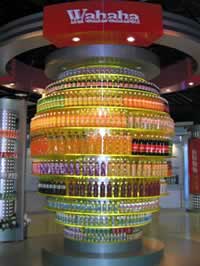 |
| Wahaha's exhibition hall at its corporate headquarters in Hangzhou, Zhejiang. Photographs: Paula M. Miller |
The company's founder and two retired schoolteachers initially sold milk
products and popsicles out of a school store.
Wahaha's second large-scale
expansion occurred in 1994 when the company merged with three insolvent
companies in Fuling, Sichuan, to set up its first factory in Chongqing.
Establishing a factory in Chongqing helped the company in two ways. The location
provided Wahaha with a manufacturing base in western China, enabling the company
to reduce distribution costs. And the merger occurred when the central
government was providing coastal companies incentives to invest in the west.
In 1996, Wahaha joined with Groupe Danone SA to form five new subsidiaries,
of which Danone owns 51 percent and Wahaha the remainder; Danone now owns 30
percent of the whole company. With Danone's assistance, the company was able to
invest in advanced production lines and improve efficiency. Thanks to the
mergers and joint ventures, Wahaha's production doubled from 1996 to 1997.
| 1 | 2 | 3 | 4 |  |
(For more biz stories, please visit Industry Updates)