|
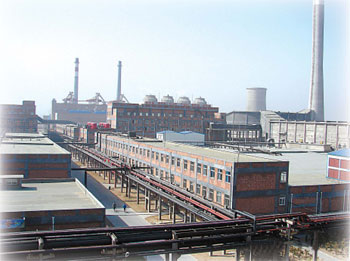
Bailu Chemical Fiber Co is a famous enterprise in Xinxiang.
|
Convergence, clustering and intensification are the three key policy guidelines to Xinxiang's scientific development, according to Wu Tianjun, the city's Party secretary.
These guidelines were drafted in response to Xinxiang's industrial makeup, Wu said during an online interview this July.
While small and medium-sized State-owned Enterprises (SOEs) occupy the main portion of the city's urban industry, its rural economy primarily relies on township enterprises that are in general small, loosely distributed and have low technology levels.
Convergence - namely, the establishment of five provincial development zones in the city and the planning of a batch of converging zones to orientate the centralization of industries for resource-sharing, land conservation and collective pollution treatment - is therefore necessitated.
Meanwhile, six industrial clusters, among them refrigeration, led by Xinfei Electric Appliances Group and auto and auto parts, pioneered by Xinfei Special Purpose Vehicle Co Ltd and Xinhang Group, have been identified by the province and are taking shape.
It is expected that the clusters will further facilitate Xinxiang's comprehensive development in the years to come. In addition, the city is focusing its efforts on intensification of, or improvement in, three areas - investment per hectare, individual companies' investment scale as well as their input-output rate.
Since Xinxiang is not abundant in mineral resources, Wu said investment promotion is particularly significant to the city. In recent years, Xinxiang has adopted a series of reform measures to facilitate investment promotion. First, it has implemented a performance supervision mechanism through a newly established performance watchdog since 2002 to ensure a sound and secure investment environment.
Government agencies' services to foreign investors are outlined as an important part of the supervisory body's agenda. Moreover, it set up a monitoring scheme on governance last year to further ameliorate the foreign investment environment.
Second, the city has established a sound administrative system where every county-level government body designates personnel to serve investors, an all-round service structure where legal corporate entry is treated on a favorable basis, and a reward system for those who have contributed to successful investment promotion activities.
Through these systematic innovations in the field, Xinxiang's investment promotion work ranked 3rd overall provincially last year, up from the 7th place in 2004 and 8th in 2005.
Sound investment promotion also relies on active and efficient pollution treatment and prevention. Since 2002, Xinxiang has amplified efforts to innovate high-polluting enterprises in construction, papermaking, spinning and machinery. In the meantime, five new cement enterprises have been set up in the city, boosting the sector's local production to 13 million tons while downsizing the local industry and saving energy consumption.
Similarly, 104 small papermaking companies were closed as five large-scale ones were fostered and renovated, effectively lowering the chemical oxygen demand discharges and contributing to energy conservation activities.
Standardized workshop construction has been implemented to save land use. To date, 200,000 square meters have been constructed while a further 800,000 is projected. The workshops' investment per mu (0.07 hectare) has reached 1.4 million yuan.
Xinxiang officials have also managed to improve individual companies' investment scale from a few million yuan to an average of 300 million yuan since 2006, and are striving to place emphasis upon those capital- and technology-intensive companies with a high input-output rate.
All such measures are aimed at a progressive transition of the local industrial structure through scientific development. On the whole, Xinxiang plans to become what Wu calls the "two bases and two centers" among the city group of Central Plains.
The "two bases" refer to the advanced manufacturing base and human resources training base among the emerging cities. Xinxiang's five post-secondary institutions and 67 vocational middle schools as well as the city's 530 million yuan investment and the presence of each of its county's professional education center are all significant advantages in realizing the latter goal.
The "two centers", on the other hand, are the model center for modern agriculture and regional logistics center for the city group. The provincial academy of agricultural science's 1.1-billion-yuan hi-tech agriculture research and development (R&D) base, the exhibition center of which opens at the end of this year, is expected to be at the core of Xinxiang's modern agriculture.
The city's vision to become the city group of Central Plains' regional logistics center, meanwhile, is founded upon the central government's positioning of Zhengzhou, the provincial capital to which Xinxiang shares proximity, as a logistics hub. Three logistics parks have already been set up in Xinxiang to complement Zhengzhou's efforts.
Analysts from a World Bank research group concluded years ago that Xinxiang and Zhengzhou, which are only a river apart, ought to be developed into a compounded metropolis, and it is precisely in line with this idea that the city administrators mandated Xinxiang's future of complementary development with Zhengzhou.
Xinxiang has not only adopted pragmatic and innovative approaches to industrialization and urbanization, but also to social development. While one of the city government's two governance mandates is to foster a sound investment environment for entrepreneurs to invest in Xinxiang, thereby enhancing employment, the other addresses the interests of socially vulnerable groups.
As early as in 2002, city officials made explicit policies to assist the local poor so that they too can reap the benefits of reform and development. Six measures were announced to deal with minimum allowance, employment, education and medicare for disadvantaged groups.
Xinxiang was Henan's first city to establish an all-round new rural cooperative medicare system, one of the earliest to implement the urban-rural minimum allowance scheme, as well as the pioneer in eradicating zero employment families in its rural regions.
|
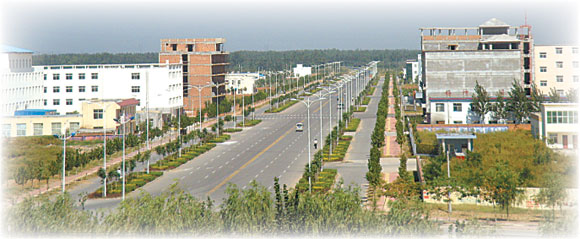
The Xinxiang Industrial Zone is a major investment destination in the city.
|
(China Daily 10/19/2007 page26)