Retailers should watch new consumer habits
Updated: 2007-11-22 10:16
Thanks to a rapidly rising middle class, China is one of the largest and fastest growing domestic markets for multinational consumer companies. But great success can bring even greater expectations. For the good times to continue, companies must look beyond China's compelling demographics and into the hearts and minds of its consumers.
 |
|
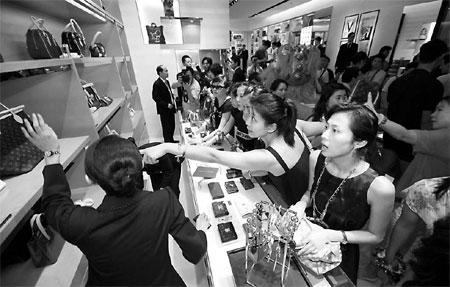
Shoppers fight for luxury Louis Vuitton luggage at the opening of the LV franchise store in Nanjing, Jiangsu Province.Song Qiao[China Daily] |
Until recently, success for many multinationals in China was driven by geographic expansion in pursuit of new consumers. Going forward, we believe that the game will slowly shift to one in which marketing becomes a source of great advantage. For at least the next decade, the top 50 cities will continue to represent a large share of urban purchasing power in China. Most major consumer-goods companies are already present in these markets and are bombarding consumers with so many promises and products that shopped readily abandon one brand to try another.
In order to win in the next phase of China's rapidly developing economy, companies must secure a marketing advantage through consumer insight and segmentation, and they must ensure lasting brand loyalty by developing superior product functionalities and emotional affiliations.
In February and March 2007, The Boston Consulting Group's Center for Consumer Insight in Asia conducted a large-scale survey in 13 cities. The survey included more than 4,000 Chinese consumers representing a range of household incomes and regional characteristics.
Our results indicate that the trends in consumer behavior that are playing out in other parts of the world are also emerging in China - often in ways that differ from other markets and across the country's top-, middle- and lower-tier cities.
China is changing and changing fast. The past decade brought prosperity but also uncertainty. A young mother in one of our focus groups expressed mixed feelings about the economy's rapid advance: "China has changed so much; my parents would never have imagined the life that I am leading now. I fear that my child's life will also change dramatically - so much so, that she will be unable to relate to me. But I believe the changes are for the better."
Such thoughts make their way into attitudes towards spending and consuming, resulting in a highly complex market in which market share can shift quickly. Armed with superior insight into consumer behavior, a relatively small player could leapfrog the competition and usurp a market leader's position with remarkable speed.
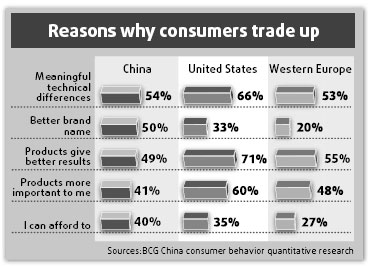
Although better salaries and living conditions have allowed many in China to trade up to more expensive products, the Chinese continue to spend as carefully and conscientiously as they did when they had less. The home appliances and consumer electronics categories, for instance, consumers are most attracted to technical or functional features that offer convenience, easy storage, durability and reliable services. In the personal-care category, they care most about health benefits and the quality of ingredients.
Rather than describe Chinese consumers either as trading up or trading down, we might more accurately characterize their spending behavior as a treasure hunt for value - even when they are paying a premium price. But as carefully planned as their purchases may be, there is no question of scrimping or going without. Instead, they are getting a good deal and exercising their talents as smart shoppers.
Chinese consumers use a number of strategies when hunting for treasures. Like consumers in other countries, they try to know market prices and compare them across stores. They buy products on sale and shop at wholesale markets. They buy off-season or defer a purchase until the price comes down. They purchase online and from catalogs, and they even buy knockoffs when the resemblance to the real thing is good.
One strategy that isn't common elsewhere is to go shopping with a group of friends and try to negotiate a group discount. Another is to shop at parallel-sourcing stores. Such retailers purchase brand-name products from alternative distributors at lower prices - lower because the distributor has eliminated some costs or because the product is near the end of its shelf life. The savings are passed on to the consumer in prices that are as much as 40 percent lower than the prices for the same brands in other stores.
When we asked Chinese consumers who bargain hunt about their reasons for doing so, more than half of them cited the ability to spend more on something else as their top reason. They also reported enjoying the "thrill of the hunt" for a product that is worth more than they end up paying. Not being able to afford anything but the cheapest products was at the bottom of the list, as it is for Western consumers.
The authors work at the Boston Consulting Group. The article is part of their report entitled "Winning the Hearts and Minds of China's Consumers".
|
|