Organization crucial to festival transport
Updated: 2008-01-26 14:06
Chunyun (Spring Festival transport) can be one of just figures for those not personally involved, but for those who have to travel, especially by train, it can be a frustrating time.
It was reported that more than four million people took trains last Saturday, the first day of the peak season for rail transport, which lasts for 40 days. Authorities from the West Beijing Railway Station were quoted as saying that more than 130,000 passengers boarded trains at the station that day and all their facilities and manpower were taxed to capacity.
 |
|
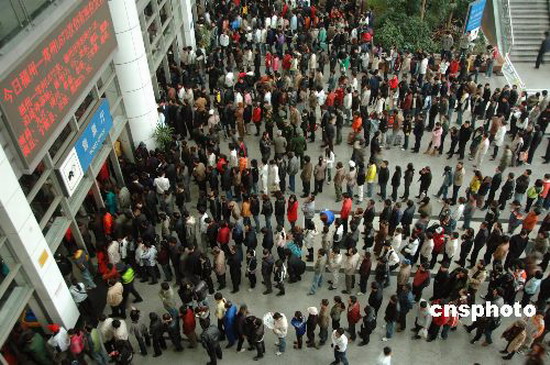
People queue to buy tickets at Fuzhou Railway Station on the first day of the Spring Festival Transport period.[Cnsphoto] |
Rail transport has always been overstretched during summer vacations and the Spring Festival for several decades. For the railways department, chunyun means the mobilization of all its transport potential - hardware and manpower- to ensure all passengers have safe journeys.
However, for passengers, it means standing for hours or even overnight in long queues to buy a ticket, elbowing their way with bags on their backs through crowds to board trains. If they are not able to get a seat, it means standing all the way home.
I can still remember the first chunyun I was involved in 30 years ago as a conductor on an extra train put into service to cope with demand. We received training on how to maintain order, familiarize ourselves with the names of stations along the line, and how to deal with passengers' queries.
What surprised me most was how crowded the train was - I as a conductor had to scramble through a window to get on board after seeing all the passengers had boarded, and doors locked.
There was no space for me to make my way through the isle leading from one end of the train to the other. The passengers were packed like sardines.
Passengers with extra large bags made the situation worse. Underdeveloped logistics and an unbalanced supply of daily necessities, rationed in different regions at the time, had forced many passengers to carry goods not readily available in their hometowns.
I remember even we conductors would often transport rice from eastern China's Shandong province to Taiyuan, capital of northern China's Shanxi province, where rice was a rarity because of a lack of water. Every person traveling would be burdened with bringing back goods for relatives or colleagues.
One of colleagues at the time told me that railway conductors kept only half of the toilets open for passengers and used the other half as storehouses to transport wheat flour and rice from grain production provinces during the "cultural revolution" (1966-76). Residents in Shanxi were subject to rationing, 30 to 40 percent wheat flour with almost no rice, and the rest was coarse corn or sorghum flour.
The situation now is totally different from three decades ago. But the gap between the ever increasing number of travelers and the much developed, but still insufficient railway system, is still large. As a result, it has become even more troublesome for people to travel during the Spring Festival.
The total length of the railway has increased from less than 50,000 kilometers in 1980 to more than 70,000 kilometers today. In addition, trains run much faster than before on most of the routes, and that has made it possible to increase capacity by adding more trains on the routes.
But the increase in passenger traffic has outpaced expansion of the rail network. Very few rural residents left their homes three decades ago. But now a majority of the 200 million rural migrant workers will be traveling home before the Spring Festival and then returning to their places of work.
The number of university students is more than 20 times it used to be 30 years ago, and quite a number of them will be traveling home by train during the festival.
In addition, the number of people who choose to spend their Spring Festival holiday traveling to scenic spots has also increased in recent years. All this has put more pressure on the rail network and other transport facilities.
The total length of the railway will be increased to about 120,000 kilometers nationwide by the year 2020, according to the national plan for railway development. Today, 16 high-speed railway lines are under construction, and construction of another 10 inter-city lines will start in a couple of years. With all these lines opening to traffic in about five years, the strain on rail transport will be considerably eased.
However, to guarantee safe journeys, organization must be thorough. Railway staff must do their best to provide a good, efficient service, special trains should be reserved for migrant workers and students, and every link from ticket sales, to embarking and disembarking needs to be better implemented.
I know from my personal experience how important proper organization helps to ease the strain on insufficient capacity and uncomfortable travel.
|
||
|
|