BIZCHINA> Wen's Lens

|
BIZCHINA> Wen's Lens
|
|
Related
Market growth
By You Nuo (China Daily)
Updated: 2008-05-05 17:14
 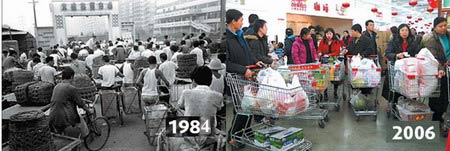 This was the beginning of an ordinary day in Beijing in 1984 when private vendors and their logistical contractors (those pushing tricycles) were ready to enter a market before it was open to customers. At the time, one phenomenon in all urban residential quarters in China was the so-called emerging "free markets" - a name that might sound too grand or philosophical to be a place where you could spend half a yuan to buy some fresh spinach or a pancake. People from other countries would simply call it a neighborhood market, grocery or bazaar. The name did sound much more significant than the immediate reality - a shabby, often unsheltered, marketplace which generated a total of several hundred yuan worth of daily sales for all vendors. It would not be generating much more considering how much all the tricycles could move in sacks and baskets. Small and makeshift as these businesses were, however, their very existence had been unlikely just a few years ago. Individuals trading items for a profit, especially without approval from administrative officials at a certain level of administration, would be subject to public criticism and reprimands, if not criminal charges. Through the most outrageous years of the 1960s and 70s, going for "free market" was regarded as a daring challenge to the notion of the "planned economy". The latter was deemed to be "purer" than the former. So when economic reforms began, no attempts were made to make the economic system "pure" by any ideological standard and people triumphantly called where they would gather and trade a "free market". Much of China today is a result of such changes that seemed as small as the sacks and baskets of the 1980s. That is why today's mammoth flourishing economy owes a debt to the old grass-roots "free market". Dominating the landscape of urban retail business, like in many other countries, are the supermarkets and glittering department stores. In a shopping mall like the one in the color picture - the first Wal-Mart in Beijing - an individual shopper's single bill could exceed the total revenue of a "free market" of the 1980s. In fact, from the beginning of its market-oriented reform to the middle of the 2000s, China's retail business (in terms of retail sales of consumer goods) saw a growth of 49-fold. The nation's total retail volume was 155.8 billion yuan ($22.68 billion) in 1978, as compared with 7.64 trillion yuan in 2006. Also in 2006, the retail industry alone, not including hospitality and catering, created at least 3.1 million jobs. But when combined, the three industries amounted to more than 8.5 million jobs.
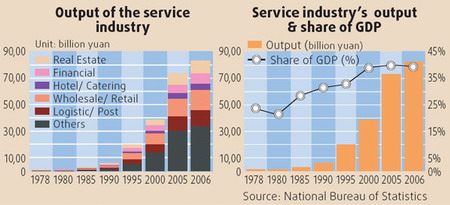
(For more biz stories, please visit Industries)
|
主站蜘蛛池模板: 定远县| 霍山县| 汶上县| 三原县| 商河县| 广河县| 盘山县| 建阳市| 太谷县| 平遥县| 凤翔县| 广东省| 博兴县| 东明县| 巍山| 左权县| 林西县| 固镇县| 兴国县| 宜兴市| 巨野县| 梅河口市| 沈丘县| 岳西县| 永年县| 乌拉特后旗| 奇台县| 福贡县| 通州区| 府谷县| 湖州市| 四会市| 全椒县| 无棣县| 剑阁县| 水城县| 盐亭县| 万源市| 奉化市| 兴仁县| 丽水市| 三原县| 神农架林区| 丽水市| 新绛县| 凭祥市| 六安市| 綦江县| 荥阳市| 山西省| 东平县| 安康市| 东阳市| 烟台市| 沭阳县| 内黄县| 北宁市| 阿勒泰市| 察哈| 永州市| 淮北市| 黔西县| 株洲市| 马边| 贵港市| 长宁区| 改则县| 赣榆县| 三门县| 通榆县| 桑日县| 连南| 长宁县| 林芝县| 安多县| 天镇县| 永德县| 镇江市| 澄迈县| 巴楚县| 海口市| 秦安县|
