BIZCHINA> Review & Analysis

|
BIZCHINA> Review & Analysis
|
|
Fitting China into your global footprint
(chinadaily.com.cn)
Updated: 2008-05-23 15:20 4. Factor in cost savings at the end To close the decision-making loop, you have to go back from competencies to products. After all, the decision to carry out a certain activity in China is not made at the level of competencies but for a tangible project, product or component. For example, you don't start developing a precision machining competency unless there is a product you plan to manufacture which requires that competency. Therefore, assess the "China fit" not only of competencies but also of products. You can do so by linking the products with the competencies embedded in them, i.e. these that are needed to develop and manufacture the product (one way to assess the dependency of a given product on a competency is to estimate the impact of the competency on the cost of the product). In other words, a product with a high "China fit" is one that makes use mainly of competencies with a high "China fit", i.e. for which China offers a strong competitive advantage and that are securely available within China. The overall "China fit" of a product is the weighted average of the "China fit" of its embedded competencies (see Exhibit 4). Exhibit 4: Example of the "China fit" of a product and its embedded competencies
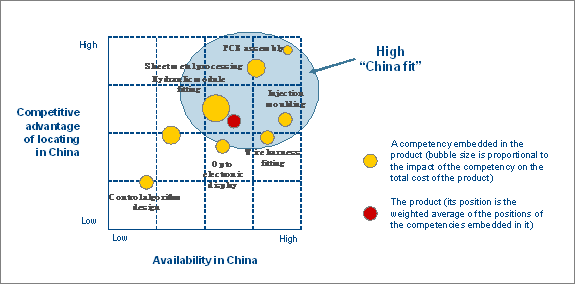 Finally, factor in the cost dimension. When comparing the "China fit" of different (future) products, product alternatives or R&D projects, compare the fit of each investment proposal with its cost savings potential. Transfer to China the proposals that come out best. Insights for the executive The "China fit" logic described above leads to a well-founded, powerful and easy-to-communicate overview of the products that could be developed and manufactured in China, and those that are better kept out. It also allows efficient comparison between alternative investment proposals. Once you have the overview, you are well equipped to focus further evaluation efforts on the alternatives that really make good sense in China. You avoid time-intensive and costly evaluation of alternatives with low potential. By linking products to the competencies embedded in them, you can define what competencies you have to develop, maintain or divest in China. From this you can easily derive your China growth strategy and the corresponding investment plan in both R&D and manufacturing. Deciding to transfer a product to China is no longer just a short-term offshoring decision, but a long-term investment in a sustainable competitive advantage. You can use the same approach for any other emerging market. The results are invaluable for the design of your global R&D and manufacturing footprint. Gert Bijnens is a Consultant in Arthur D. Little's Shanghai office, and a member of the Automotive and Manufacturing Practice. He focuses on growth strategy, innovation management and R&D in emerging markets. E-mail: bijnens.gert@adlittle.com Congjian Wu is a Manager in Arthur D. Little's Beijing office, and a member of the Automotive and Manufacturing Practice. He focuses on innovation and operations management. E-mail: wu.congjian@adlittle.com Nick Toone is a Senior Manager in Arthur D. Little's London office, and a member of the Automotive and Manufacturing Practice. He focuses on strategy and innovation in the manufacturing industry. E-mail: toone.nick@adlittle.com (For more biz stories, please visit Industries)
|
主站蜘蛛池模板: 丰宁| 沈丘县| 永顺县| 肃宁县| 阳江市| 新蔡县| 洪泽县| 油尖旺区| 蚌埠市| 广西| 岑巩县| 大埔县| 湟源县| 江山市| 阿坝县| 乌鲁木齐县| 图木舒克市| 桑植县| 麻栗坡县| 富蕴县| 嘉义市| 江孜县| 利辛县| 琼结县| 宿州市| 石阡县| 万载县| 仪陇县| 永胜县| 宜宾县| 秭归县| 珠海市| 上栗县| 巴里| 广宗县| 岑巩县| 吉林省| 牙克石市| 连江县| 夏河县| 南江县| 昌乐县| 河源市| 巴楚县| 蓬安县| 平陆县| 江阴市| 福建省| 突泉县| 南开区| 罗城| 北川| 鹤峰县| 枞阳县| 顺平县| 大城县| 闽清县| 巴马| 唐山市| 淮南市| 阜南县| 赤壁市| 新余市| 桐柏县| 太康县| 南澳县| 岱山县| 江源县| 三都| 伽师县| 周至县| 兴化市| 武隆县| 临武县| 湘西| 禹州市| 千阳县| 阿合奇县| 霍州市| 通榆县| 镇沅| 崇仁县|
