BIZCHINA> Wen's Lens

|
BIZCHINA> Wen's Lens
|
|
Related
The task ahead
By You Nuo (China Daily)
Updated: 2008-06-09 17:16
 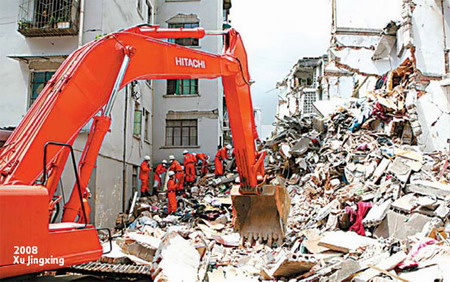 Victims of the recent Sichuan earthquake are laying the ground for rebuilding their lives. With soldiers and volunteers from all over the country, they are knocking down the dangerous old buildings, clearing up the debris, and starting to rebuild - first with makeshift residential quarters, and then to implement the plans for new cities. The current color photo, taken by China Daily photographer Xu Jingxing, shows how this is going on in the quake zone. Our 1976 black-and-white photo, taken by Wang Wenlan, shows rebuilding in Tangshan following the quake there.
 On June 3, the State Council, or the Chinese cabinet, commissioned the feasibility study for long-term redevelopment of the quake zone. To be sure, rebuilding cities in an earthquake zone is never easy, but rebuilding in Sichuan is going to be particularly difficult if all the people who lost their homes are to be resettled in their old locales and lifestyles. There will be daunting challenges and the overall task is huge. The Chinese press reports that there are at least 5 million of them, and the number of homeless could be as high as 15 million. Second, there is a time pressure. Neither the government nor the general public can allow people in the quake zone to spend years in tents or other temporary dwellings. After the Tangshan earthquake in 1976, some people could not move into their new houses for close to 10 years. But so much waiting is inhumane and with a much stronger economy now, China must provide the victims with the proper housing arrangements as quickly as possible. Third, it is almost impossible, and too dangerous in some cases, to rebuild the collapsed cities and towns on their original sites. Former residents of some cities and towns on the fault line will have to be relocated to safer places. The government has yet to tell us how many people will have to be resettled. Judging from the past experience, the largest government-sponsored relocation program for the Three Gorges Dam project involved only 1 million people. Presumably, the future Sichuan relocation program will include many more people. Fourth, a new land development model will have to be introduced. In China - let alone Sichuan - it is already impossible to find new land resources for relocating up to 15 million homeless people if they are to remain farmers. The new cities, no matter where they are to be built, will have to be of considerable size and able to provide their residents with suitable jobs. Only cities can use land resources more economically and generate a larger variety of jobs and opportunities for the locals. That task would be like relocating almost the entire population of Florida and putting all of them into one or several cities. This is something that neither Beijing, nor any government in the world, has ever done before. But China has no dearth of experience in building cities in a few decades' time. It has been building new cities through its reform era - like Shenzhen and Zhuhai in the 1980s, Shanghai's Pudong in the 1990s, Tianjin's Binhai and Tangshan's Caofeidian in breathtaking speed. Wherever the government is willing to give a full play to the private sector's initiatives, there is more rapid urban development.
(For more biz stories, please visit Industries)
|
主站蜘蛛池模板: 沈丘县| 云阳县| 巴彦淖尔市| 锦州市| 泾源县| 航空| 博白县| 涞水县| 隆回县| 衡水市| 萨嘎县| 新绛县| 屏南县| 岑溪市| 石景山区| 宝丰县| 吴忠市| 弋阳县| 南乐县| 泰宁县| 垦利县| 吴江市| 佛学| 类乌齐县| 本溪市| 康乐县| 嘉禾县| 石林| 阳江市| 景宁| 闽侯县| 西乌珠穆沁旗| 望谟县| 赣榆县| 东至县| 阿荣旗| 邻水| 通江县| 宣汉县| 嘉祥县| 遂平县| 来凤县| 土默特右旗| 天祝| 三台县| 高安市| 榆树市| 钦州市| 镇原县| 青田县| 连山| 牡丹江市| 咸丰县| 英山县| 连州市| 株洲市| 汉寿县| 蓝田县| 连平县| 岑巩县| 普定县| 万安县| 库尔勒市| 陵川县| 囊谦县| 驻马店市| 尉犁县| 临沂市| 陇西县| 安吉县| 大新县| 湟源县| 涞源县| 荃湾区| 阿巴嘎旗| 普兰店市| 神农架林区| 库尔勒市| 读书| 云霄县| 大洼县| 黄梅县|
