|
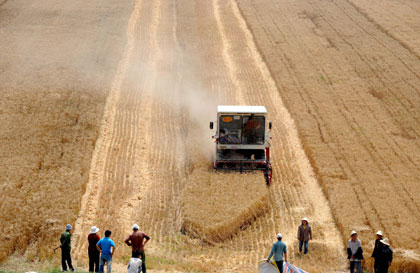
Farmers harvest wheat in Yuanyuang county, Henan Province, a major wheat producer in China, in this June 4, 2008 photo. China is set to have a bumper harvest of summer crops this year.[Xinhua]
|
China's agricultural authority has expressed confidence in the summer harvest, as farmers around the country have put over half of the output into granary with the rest to be cropped before the end of the month.
A Ministry of Agriculture official said that major grain production areas are poised to sustain a bumper summer crop for the fifth year in a row, maintaining the rising momentum in grain production.
Summer crops, mainly cereals of rice and wheat, constitute 23 percent of the country's annual grain harvest. It has grown for four consecutive years to reach 501.5 million tons in 2007, almost level with the country's annual consumption.
"The summer harvest, which comes amid global food crisis, reassures the world's most populous country of its domestic food safety," said Han Jun, head of the rural section of the State Council Development Research Center.
Farmers and agricultural experts here attribute the successive harvests not to the weather conditions for crop growth but to the government's policy impetus for grain production.
After harvesting wheat from his cropland of 3 mu (0.2 hectares), Jiao Xiqing, a farmer in Huawang village in China's major agricultural province of Shandong, seeded corn.
"The wheat, half a year of yield on my land, would be sold for at least 2,100 yuan ($300) at the state's grain purchase price. And I had another 240 yuan of grain subsidy on my bank account right before the harvest," he said.
The state's protective grain purchase price and grain subsidy have been the two effective measures for the Chinese government to keep farmers to grow grain, said Zeng Liying, State Administration of Grain deputy head.
Chinese farmers have no longer been worried about selling grains, since the government began to set the grain purchase price in 2004. They can sell grains to the government via designated state-owned grain companies at a "protective price," if the market price falls lower.
By adjusting the purchase price, the government took the consideration of inflation, said Zeng, adding the purchase price was lifted by 2 percent to 7 percent in major grain production areas in May, based on the standard set in February.
Agricultural authorities in grain production areas also raised the standard of agricultural subsidy, hoping to offset the rising cost of farming means.
The central government promised at the beginning of the year to spend 562.5 billion yuan to support farmers, 130.7 billion yuan more than that in 2007. In March, it said it would earmark another 25.3 billion yuan to boost grain production in particular.
The State Administration of Grains predicted that price stability can be ensured, thanks to abundant grain reserves.
"China has abundant grain reserves standing at 150 million to 200 million tonnes," said Chinese Premier Wen Jiabao during a grain production inspection in the northern Hebei Province earlier in April.
He pledged a consistency in the policy supports to farmers and agricultural provinces during his trip to oversee grain production in Henan Province in May.
Han Jun, the agricultural expert, said China did not make bulk imports of cereal during the past four bumper years. The country's self-sufficiency policy for its colossal population is its huge contribution to the stability of the world's food market.
He said the policy impetus would continue to be key to stimulate the enthusiasm for grain production amid the price rise.
China's consumer price index, the main gauge of inflation, in May was 7.7 percent up from the same period last year, the National Bureau of Statistics said on Thursday.
Yin Jianfeng, an economist with the Institute of Finance and Banking at the Chinese Academy of Social Sciences, said soaring grain and oil prices on the international market greatly contributed to the country's inflation.
The price of wheat on the international market skyrocketed by 112 percent last year, while that of corn rose by 47 percent.
According to the United Nations World Food Program, the onslaught of the global food crisis, the most severe since World War II, is threatening the UN-backed feeding programs for 20 million children, and driving 100 million people into the ranks of poverty. Developing countries, where food takes the lion's share of household income, suffered most in the food crisis.

