BIZCHINA> Newsmakers

|
BIZCHINA> Newsmakers
|
|
Related
SK's LS looks to overseas markets
(China Daily)
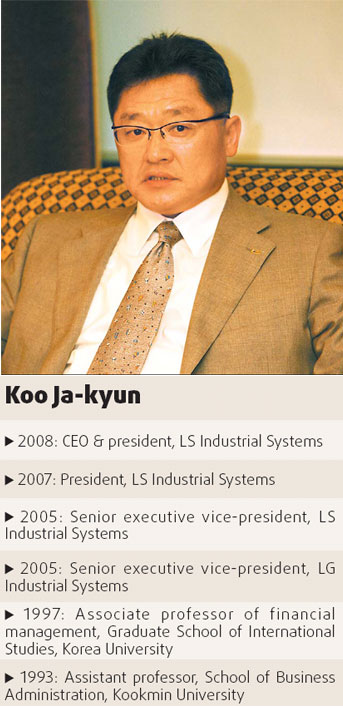
Updated: 2008-06-24 11:14 South Korea-based LS Industrial Systems (LSIS) Co Ltd, a spin-off group of its local conglomerate LG Industrial Systems, has dominated the field of industrial electric and automation in South Korea for over 20 years, occupying 60 percent of its domestic market share in electric equipment production. Its total turnover in 2007 was projected at $1.3 billion, with a 27 percent average growth ratio since 2002. But the home-grown company is not satisfied as a local brand, and is aggressively stepping out of the Korean Peninsula to zero in on exploring overseas business opportunities. After being appointed CEO and president of LSIS early this year, Koo Ja-kyun talked to China Daily reporter Zhou Yan regarding the company's globalization strategy and long-term visions. Q: It has been five years since LS spun off from LG group, what do you think of the company's performance since then?
A: LS group was separated from LG group in 2003, when the sales revenue reached $7.4 billion. Through almost half a decade of progress, LS has more than doubled its turnover, gaining $15 billion in 2007. LSIS is among the major six companies affiliated to LS group, providing services ranging from industrial electric, electronic, to energy and material businesses. We have been leading the fields of automation solutions and electric machinery for over 20 years in South Korea, and earned $1.3 billion last year. We have four factories and three R&D centers in South Korea. Our three overseas factories are respectively located in China's Dalian and Wuxi, and Vietnam's capital Hanoi. In addition, LSIS' sales outlets are scattered throughout 65 countries around the world. Q: Your company has achieved recognized success at home in South Korea, and now LS Industrial Systems has put globalization on the agenda. How's your performance overseas so far, in particular in China? A: About 70 percent of our revenue achieved last year was from South Korean market, but we see much larger opportunities beyond our country, and therefore are determined to accelerate our exploration pace in markets abroad. Our history in China could be referred back to 1997, when we set up our first company in Dalian to manufacture and produce distribution series, protection devices, and electric switches. We set up our second factory in Wuxi in 2005 in light of our needs of business expansion in this country. We've perceived that the Chinese sector contributed to 30 percent of our overseas market in revenues last year, and the figure is still constantly rising, roughly with a 50 percent rate. Currently, LS Industrial Systems owns 13 subsidiaries in China with 800 employees. We are a company that strives for greater social responsibility. We are deeply sympathizing with the earthquake victims that suffered the tremor in Sichuan. We donated 3.6 million yuan ($523,734) in cash to the disaster areas for relief. And we are continuing to take part in more public welfare activities in China. Q: What are your expectations for LS Industrial Systems' Chinese business in the long run? A: We're planning to expand our investment in research and development, productivity, as well as in branding and marketing here in the country. We also intend to augment productivity in our Wuxi factory soon. In addition, our sales marketing networks will be increased to 15 points from 11 by 2008, and three extra repair centers will be built bringing our total to 24 this year. A research institute for electric and automation will be put into use in Shanghai to develop a series of products tailored specifically for Chinese people this year. We also plan to increase our presence in the northeast and inner cities. Our long-term goal in China, through the above development planning, is to achieve $500 million sales revenue in 2012 to further consolidate our first tier status in Asian region. Q: Many multinational companies providing industrial electric and automation products have entered China, how can you compete with and differentiate yourself from your rivals? A: The Chinese market in the electric field still has room to grow. We will continue to dive into investment in China, and to strategically cooperate with top academic institutions to strengthen our R&D capabilities. Also, as we've noticed that electric and automation industries in China still lags behind some developed markets in terms of pertinent equipment and production management, we will introduce advanced management approaches to facilitate the progress of our Chinese companies. "Localization" is kernel for our development, and therefore, recruiting local engineers and marketers is our priority in stimulating localization. LS Industrial Systems sends our employees overseas for training. And our close cooperation with leading Chinese universities guarantee that we get the best young talent in the country working for us. Q: As a newly-appointed CEO of LSIS, could you share with us your long-term visions for the company? What strategies are you going to take to achieve these goals? A: We are rooted in South Korea, but our ambition is to walk out our birthplace to build up a global brand serving local clients with customized products. Given our vision of being "innovators of innovation", we are dedicated to putting an emphasis on creativity and pioneering offering hi-tech products and quality services beyond our customers' expectations. Our goal is to gain $4.5 billion revenue by 2015, and to make $700 million profit by then. (For more biz stories, please visit Industries)
|
主站蜘蛛池模板: 凯里市| 太谷县| 濮阳县| 宁强县| 马尔康县| 华蓥市| 克拉玛依市| 双辽市| 惠安县| 饶平县| 福贡县| 闽清县| 庆云县| 施秉县| 祥云县| 比如县| 富源县| 苏尼特右旗| 新巴尔虎左旗| 松溪县| 许昌市| 玛纳斯县| 肇州县| 钟山县| 鄂托克前旗| 宣威市| 商都县| 永寿县| 河北区| 茂名市| 湘乡市| 炎陵县| 龙陵县| 福贡县| 措美县| 卢氏县| 炎陵县| 和田市| 左贡县| 石首市| 临安市| 石家庄市| 和静县| 彝良县| 安龙县| 旅游| 龙井市| 开化县| 凉城县| 台南县| 彭州市| 鄄城县| 洞头县| 泗水县| 玉环县| 洛隆县| 南丰县| 望都县| 临武县| 祁门县| 泸溪县| 赫章县| 铁岭县| 彰武县| 津南区| 于都县| 含山县| 金湖县| 含山县| 文成县| 高雄市| 建水县| 政和县| 昌黎县| 嘉兴市| 天长市| 邵东县| 崇明县| 邵阳县| 莱州市| 兴化市| 克什克腾旗|