BIZCHINA> Center

|
BIZCHINA> Center
|
|
Related
Rising prices eating into farmers' income
By Fu Jing and Wang Lan (China Daily)
Updated: 2008-07-25 09:14
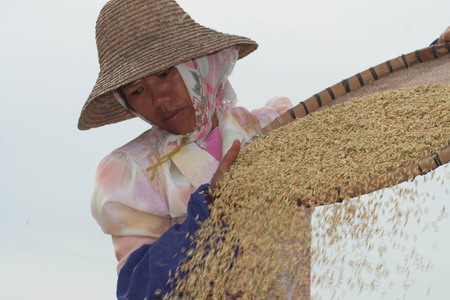
A dozen Big Macs - that is what a Chinese farmer will be able to buy with his earnings from one mu (0.066 hectares) of wheat this summer. It is also about four burgers less than what he could afford last year. Farming one mu of wheat will yield 153 yuan ($22) of net income this summer, a recent official survey on farmers' income has showed. Rising production costs was cited as a major reason behind the decrease in income. "In spite of growing government subsidies in agriculture, we should be alarmed that it's increasingly hard for farmers to grow their income amid rising costs," the country's top legislative body, the National People's Congress (NPC), said in a recent bundle of suggestions to the central government. The NPC's suggestions were followed by an announcement from the National Bureau of Statistics yesterday, which said that farmers' per capita income hit 2,528 yuan for the first half of the year, an increase of 10.3 percent over the same period last year, after adjusting for inflation. About one-third of the farmers' income is also reportedly earned from their stints as migrant workers in factories, mines and construction sites, while the sale of farm produce was said to have helped them earn 1,080 yuan each, up 22.1 percent year-on-year. But the pace had slowed by three percentage points, when compared with the growth rate of 13.3 percent in the first half of last year. The decrease is considered a wide fluctuation since 2004, when the growth rate of farmers' income started to accelerate after years of less than 5 percent annual growth. Similarly, thinner profit margins have forced the farmers to downsize their planting acreage. Li Taiai, a 58-year-old farmer in Zhongcaiwan village of Shandong province, said the land for growing grain in his village has shrunk by one-third in the past five years. "More and more grain growers are shifting to planting vegetables, which can generate much higher profit in a shorter time," Li said. Just a few years ago, half of the land was used to grow wheat and other grain, he said. For instance, the yield from a mix of cucumber, tomato and radish per mu can amount to 5,000 to 6,000 yuan each season, which is more than 10 times that of wheat. "Vegetables from our village are sold not only in China but also exported to Japan and South Korea," Li said. "The increasing demand and plus decent prices in turn continues to attract more growers to cultivate vegetable greenhouses instead of wheat fields." In response to such trends, the authorities have rolled out measures to protect grain purchase prices and given out grain subsidies to encourage farmers to grow grain. In the beginning of the year, the State Council approved 95.06 billion yuan in subsidies for farmers - with 1 billion yuan going to those who grew wheat and oilseed. Similarly, the central authorities vowed this year to spend 562.5 billion yuan to support farmers and the rural sector, 130.7 billion yuan more than last year. It decided in March to allocate another 25.25 billion yuan to this year's budget for the sector, mainly to subsidize farmers' purchase of seed, diesel, fertilizer and other production costs. To further secure the country's food and grain reserves, the government has also worked out compulsory requirements on planting areas and varieties of grain being farmed. Still, farmer Li said a "protective price system" to ensure grain prices did not guarantee a steady increase income along with the rise in costs. The prices at which grain was being sold to collectives remained more or less the same over the past several years, Li said. "But fertilizer and fuel costs have continued to increase," Li said. "Our net income has, in effect, dropped from the year before." (For more biz stories, please visit Industries)
|
主站蜘蛛池模板: 夹江县| 阿尔山市| 鲜城| 蓝田县| 浮山县| 大厂| 博客| 留坝县| 滦平县| 罗平县| 民权县| 宁河县| 鹰潭市| 简阳市| 德惠市| 利津县| 台中县| 绿春县| 若尔盖县| 横山县| 连平县| 太湖县| 特克斯县| 靖安县| 晋宁县| 离岛区| 赫章县| 剑川县| 南投市| 射阳县| 靖江市| 安义县| 南靖县| 南投市| 渭源县| 若尔盖县| 长顺县| 方山县| 淮阳县| 通江县| 会昌县| 榕江县| 金堂县| 乃东县| 陇川县| 米易县| 鸡泽县| 广安市| 驻马店市| 抚州市| 金溪县| 营山县| 辽源市| 成武县| 嘉兴市| 西林县| 沈阳市| 汝南县| 布拖县| 金川县| 富蕴县| 图们市| 营山县| 乐安县| 太和县| 嘉义县| 广河县| 英德市| 嘉定区| 泰顺县| 茂名市| 芮城县| 盐城市| 平乐县| 怀安县| 黑河市| 平远县| 青州市| 准格尔旗| 离岛区| 洛浦县| 马龙县|