BIZCHINA> Review & Analysis

|
BIZCHINA> Review & Analysis
|
|
Related
Saving every drop to nourish the corn belt
By He Na (China Daily)
Updated: 2008-09-02 10:59 In Jilin, the main factor that has hampered agricultural development is lack of water due to a poor farmland irrigation system. Although the province has had good crop yields for five consecutive years, it is still beset by frequent natural disasters.
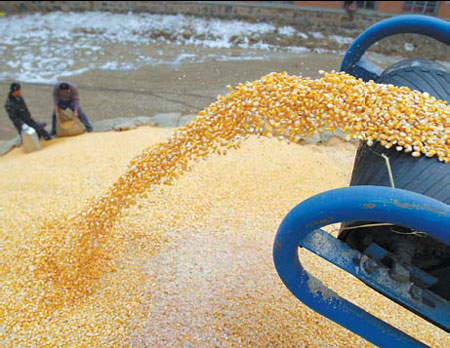
"We can raise our grain production capacity if we can improve water conservation," said Su Zheng of the water resources department of the Jilin province. Cui, whose village on the edge of the Songnen plain is one of the country's major corn producers, agreed: "Without a good water conservancy project, droughts and floods still threaten our crops every year. Due to a severe drought last year, our yield was only a little more than 11,500 kg." Most of the villagers rely on well water. The well water, Cui said, was "only enough for drinking and our daily use. Other than praying for rain, we could do nothing to relieve the drought." The central government has increased its investments in construction of farmland irrigation in recent years, but they have mainly been for projects along major rivers, large reservoirs and for flood control in urban areas, according to Su of the Water Resources Department. Little of the money has trickled down to small and medium sized systems, he added. Most of the irrigation systems in Jilin province were constructed some 40 to 50 years ago, and all have leaks, Su said. No money has been invested in the province's 135 medium-sized irrigation systems since then. Small fields like Cui's rely mainly on small and medium-sized reservoirs, and small river basins. "As long as natural disasters strike, grain output will decline," Su warned. The province has just launched a 26 billion yuan program to address these issues in hopes of increasing its grain output by more than 5 billion kg within the next five years. Jilin Vice-Governor Wang Shouchen, who is in charge of agricultural affairs, said: "The program includes 10 major projects such as water diversion, expansion of the irrigated area of Jilin's central and western regions, further mechanization of farming, cultivating and popularizing the use of improved seeds and disseminating the use of advanced farming techniques." Jilin governor Han Changfu, said that through improved water conservation, land reclamation, cultivation of high-grade farmland, promotion of mechanization and popularization of new grain seeds, the province hopes to see its annual grain production capacity rise from the current 25 billion kg to 30 billion kg in five years. Experts have expressed optimism for the average grain output per hectare of land to increase given sufficient irrigation. The State Council approved the program in early July. Jilin has positioned itself as a pillar of the country's longstanding policy of maintaining 95 percent self-sufficiency in grain. The province hopes to become the country's fifth-biggest grain producer after Henan, Shandong, Jiangsu and Heilongjiang provinces. (For more biz stories, please visit Industries)
|
主站蜘蛛池模板: 尚志市| 厦门市| 韶山市| 谢通门县| 徐水县| 沧州市| 宁河县| 佛坪县| 临高县| 都兰县| 儋州市| 五峰| 即墨市| 华坪县| 彰化市| 绍兴县| 托里县| 泸水县| 桂阳县| 凌云县| 迁安市| 江达县| 高青县| 千阳县| 津南区| 蕲春县| 荣成市| 大厂| 南平市| 留坝县| 贵德县| 安国市| 河东区| 交口县| 澎湖县| 武冈市| 克什克腾旗| 团风县| 南和县| 九江市| 梧州市| 鞍山市| 遵义市| 唐山市| 太谷县| 凤城市| 天台县| 恩平市| 招远市| 兰西县| 濉溪县| 乐亭县| 孟村| 怀化市| 金湖县| 塔城市| 乌鲁木齐市| 读书| 桐柏县| 开远市| 大庆市| 潜江市| 临沭县| 潮安县| 新乡市| 双城市| 鹤峰县| 蓝山县| 东乡县| 贺州市| 天柱县| 新营市| 会昌县| 津南区| 北票市| 利辛县| 隆昌县| 噶尔县| 合江县| 岐山县| 桃园市| 镇坪县|