BIZCHINA> Review & Analysis

|
BIZCHINA> Review & Analysis
|
|
Reform land system to protect farmers' rights
By Dang Guoying (China Daily)
Updated: 2008-09-16 14:40 At a special meeting held by the Chinese People's Political Consultative Conference on September 2, Zhu Zhixin, vice-minister of the National Development and Reform Commission, pointed out five outstanding problems in the country's overall planning for urban and rural economic and social development. These problems include farmers' land rights not being effectively protected, their land being sometimes expropriated at lower compensations or with delayed compensations, and disputes over land requisition becoming frequent. We should have a systematic probe into the reasons why there have been so many violations of farmers' land rights and interests in some regions in recent years. Such violations are happening although the central government has repeatedly issued regulations to protect farmers' land interests and vowed to adopt strict land management policies. The current land ownership practiced in rural areas is much similar to the joint ownership defined in the Property Law which took effect on October 1 last year. Under this kind of joint ownership, farmers' land belongs to the collective of their village and any withdrawal from this arrangement would mean their relinquishment of their property rights. Despite its low efficiency, the joint ownership model, however, has to pay a high management cost. Also, a democratic system is needed to prevent joint property from being manipulated by a few powerful individuals or groups. In view of its low efficiency and difficulties in its management, the country should try to spread the co-ownership model to as many rural areas as possible and reduce the application of the joint ownership to a minimum.
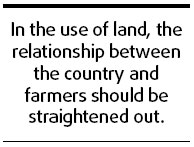
To the land related to the environment and infrastructure, the joint ownership, and the State ownership at best, should be applied. Similarly, to the land related to community, such as the land for village roads and schools, a kind of community ownership can also be applied. But as for the arable land, the model of co-ownership should be practiced, and we should also allow farmers to withdraw at their will. A multiple ownership model will yield a higher efficiency in land use. In fact, the late leader Deng Xiaoping had realized some maladies at the early stage of the application of the joint ownership - like the rural collective ownership for the economic system - and then began to push for the family contract responsibility system throughout the vast rural area. This has substantially boosted creativity and productivity in rural areas. The adoption of the contract responsibility system indicated it was necessary and also viable to put land under a household unit. However, there still existed some imperfections in the reform of land ownership from the collective to the family responsibility system although the government promised to give farmers land contract tenures of 30 years or longer. In the current rural conditions, village officials often have the largest say in land utilization and management. They sometimes do not hesitate to compromise farmers' land rights if they believe such actions bring them profits. In this situation, the land contract right of individual farmers remains particularly vulnerable to the group organized by collective resources. Without fundamental changes to the situation, cases of infringement upon the land right of farmers would not be stopped in the future. Currently, land disputes serve as the largest factor affecting the country's stability in the vast rural area. The government should transmit a strong signal of protecting farmers' land rights through a series of land system reforms, such as granting farmers a permanent land contract right and allowing for the transfer of contract right, rent, mortgage and inheritance. Of course, any kind of land use should be in accord with the country's overall land development program. Farmers, for example, are not allowed to sell their land randomly to real estate developers. Also, a series of regular legal procedures should be set up to solve disputes emerging in the use of local land. An independent body or court of arbitration, but not village officials, should have the largest say in this process. In the use of land, the relationship between the country and individual farmers should also be straightened out. For the interest of the public, the country is certainly qualified to requisition farmers' contracted land according to its overall development layout. However, any land acquisition from farmers should not be made for the benefit of a concocted collective and farmers should get their fair compensations. Any forcible land acquisition in this process should be stopped. To deepen reforms in the country's land system in these directions is beneficial not only to individual farmers but also to the country's overall development. The author is a researcher with the Chinese Academy of Social Sciences. (For more biz stories, please visit Industries)
|
主站蜘蛛池模板: 玉溪市| 韶山市| 巴马| 雷州市| 宝丰县| 丹东市| 辽宁省| 海阳市| 新蔡县| 井冈山市| 义乌市| 安塞县| 星子县| 岳阳市| 麦盖提县| 牡丹江市| 囊谦县| 亳州市| 南溪县| 上饶县| 屏南县| 安陆市| 湖南省| 栖霞市| 丹江口市| 高雄县| 斗六市| 丰县| 鹿邑县| 广平县| 册亨县| 乌审旗| 吉木乃县| 东乌珠穆沁旗| 苍溪县| 肥城市| 黄浦区| 新民市| 葫芦岛市| 丁青县| 洞口县| 铜鼓县| 岐山县| 阿拉善左旗| 左云县| 买车| 台前县| 徐汇区| 红安县| 新河县| 名山县| 秦安县| 棋牌| 连城县| 焦作市| 奉新县| 郎溪县| 朝阳市| 剑川县| 沁阳市| 娱乐| 阜新市| 无棣县| 万安县| 兖州市| 东兴市| 甘谷县| 辽阳县| 偃师市| 博湖县| 河间市| 崇明县| 罗源县| 曲沃县| 罗源县| 赤峰市| 平度市| 汪清县| 诏安县| 宣汉县| 桃园市| 赫章县|