BIZCHINA> Review & Analysis

|
BIZCHINA> Review & Analysis
|
|
Related
China needs to expand foreign investment scale
By Zhao Jinping (China Daily)
Updated: 2008-10-09 14:14 Over the past five years, around 30,000 to 40,000 new foreign investment projects have been approved in China every year, with an annual investment exceeding $60 billion. The figures were 300 and $600 million respectively in the first five years after the country's adoption of the reform and opening-up policy in 1978. According to statistics released by the Ministry of Commerce, China absorbed $83.50 billion worth of foreign direct investment (FDI) last year, 91 times as much as that in 1983. The country has ranked No 1 among developing countries for 15 years in succession in terms of the scale of its FDI. Foreign investment has long been a main fund source for the country's fixed asset investment. During the early period of reform and opening-up, in particular, the inflow of overseas investment did greatly help ease its serious fund shortage. At the same time, the rapid expansion of FDI also contributed a lot to the country's process of industrialization. Among all foreign investments, the industrial sector has taken more than 70 percent of the total. Foreign-funded enterprises have served as an important source of tax in China's revenues. In 1995, these enterprises handed in 8.9 percent of the country's total corporate income tax, and the proportion increased to 20.2 percent last year, reaching $195.1 billion. Due to the inflow of foreign investment and the increase in the number of foreign-funded enterprises, a lot of employment opportunities have been created. Last year, such enterprises offered about 15.83 million jobs to Chinese laborers, compared with 60,000 in 1985. If relevant processing and service sectors are taken into consideration, the figure would amount to 26 million. At the same time, the utilization of foreign funds has also optimized and upgraded the country's industrial structure.
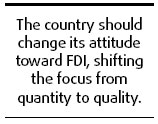
The import and export in foreign-funded enterprises has been an important driving force behind the growth in the country's trade. Currently, the exports of 88 percent of the country's high-tech products and 74 percent of its mechanical electrical products are realized by foreign-funded enterprises respectively. The utilization of foreign investment has also played a vital role in pushing for China's reform and improvement of its market economic system. Since its entry into the WTO, China has gradually integrated itself into international practices in terms of foreign-related economic regulations and rules. Foreign investors have also brought to the country advanced organization and management know-how and models together with funds. These have prompted their domestic counterparts to improve management levels and pushed forward the country's reforms on economic system and marketization. However, with the expansion of foreign investment, problems have gradually emerged in its utilization. For instance, some multinationals fail to fulfill our expectations in technology transfer. In their thirst to attract foreign investment, some local governments have also intentionally or unintentionally given a green light to the malpractices of some foreign-funded enterprises, resulting in such problems as environmental pollution, plundering of resources and social contradictions. For a long time, foreign investment has mainly focused on China's eastern regions, which would not be helpful to the country's effort to narrow the east-west gap. Also, it has mainly concentrated in industrial fields and labor-intensive processing sectors rather than in the development and application of new agricultural technologies and agricultural industrialization or knowledge- and capital-intensive sectors. High-tech industries with high, added values have not received as much investment. Given its comparatively big base and ever-increasing international competition, the speed of China's absorption of foreign investment is not expected to be as fast as it was in the past. But, the country should not cite any excuses to close the door on foreign investment and foreign-funded enterprises. Experiences at home and abroad indicate that any direct investment by multinationals armed with sophisticated technologies, management expertise and marketing tactics will bring the host country more returns and higher efficiency. That is exactly what China needs on its way to the building of a comparatively prosperous society. In terms of the amount of foreign investment per unit GDP, China lags behind many developing countries. World experiences show that the country still has a large space to expand its foreign investment scale. China is in the process of industrialization, and the injection and accumulation of capital factors will still be crucial to pushing forward its economic development for a long period of time. On its way to modernization, absorbing foreign investment will play an irreplaceable role in raising its industrial division of labor and enhancing its international competitiveness. In the process, the country should also change its attitude toward foreign investment, shifting the focus from quantity to quality. The author is a researcher with the Development Research Center of the State Council (For more biz stories, please visit Industries)
|
主站蜘蛛池模板: 保靖县| 铜鼓县| 平塘县| 白朗县| 修文县| 武夷山市| 花莲市| 揭阳市| 寻甸| 静宁县| 长春市| 中卫市| 永川市| 济阳县| 昆明市| 土默特左旗| 沐川县| 永康市| 子长县| 廊坊市| 辽阳县| 乌海市| 连城县| 内黄县| 聂拉木县| 陕西省| 电白县| 鹤岗市| 舒兰市| 西乌珠穆沁旗| 曲靖市| 浦城县| 罗平县| 竹山县| 安泽县| 崇仁县| 长沙市| 武安市| 彭水| 礼泉县| 麟游县| 丰都县| 论坛| 丰顺县| 宽城| 昌江| 宣化县| 望江县| 从化市| 茶陵县| 漳州市| 信阳市| 北京市| 长沙县| 满城县| 富宁县| 田东县| 桦川县| 砚山县| 安达市| 清水县| 乐陵市| 芦溪县| 汨罗市| 新竹县| 孙吴县| 竹溪县| 砚山县| 韩城市| 永城市| 镇平县| 大安市| SHOW| 龙海市| 黄大仙区| 毕节市| 神池县| 公安县| 仁怀市| 呈贡县| 汶川县| 嘉黎县|