BIZCHINA> News

|
BIZCHINA> News
|
|
Steel mills struggle to survive a downturn
By Wang Xu (China Daily)
Updated: 2008-11-03 09:27 For Andy Lin, the last quarter of the year used to be his busiest time. As the human resources director of Hebei Yuansheng Iron & Steel Co Ltd, he would start to work on the annual review of the company's some 1,000 employees and then prepare their bonus packages. But there won't be any bonus this year.
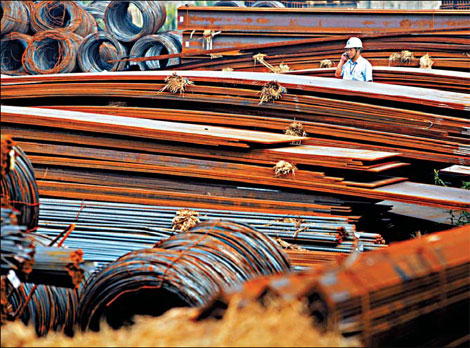 About a month ago, Lin's company, a small steel mill in Wu'an, Hebei province, had to suspend its operations as months had gone by without any new orders and stockpiles continued to build up. Most of the plant's workers were then sent back home, without knowing when they would return. Now, only a handful of employees still go to the plant every day to look after the once busy site. "Most of Wuan's steel firms have closed down," says Lin. "It looks like we won't be able to resume production by the end of the year." Lin's company is just one of the steel mills struggling to survive a downturn in China's steel industry. Thanks to a property slump and the global economic slowdown, the sector has come to a crossroads after a five-year boom. Turning point Established in 2002, Lin's company mainly produced steel bars widely used in the construction industry. Trying to ride the property market boom, the company more than doubled its annual production capacity to 1 million tons in 2006. And over the past two years, it had little to worry about except how to cope with orders that kept flooding in.
The company's fast expansion epitomized the blistering growth of the entire steel industry. Between 2002 and 2007, the nation's steel production grew from 180 million tons to 489 million tons. Meanwhile, it also transformed from the world's largest steel importer to the largest exporter, with about one-eighth of its 2007 steel output sold overseas. For many players in the steel sector, the sizzling growth over the past five years only appeared to be a prelude as analysts claimed the nation's ongoing urbanization and infrastructure construction would guarantee the sector's long-term prosperity. To back up their argument, they pointed out that the nation's average steel consumption was only 328.7 kg per capita in 2007, about one-third of Japan's. Yuansheng was one of the optimists. Last September, it decided to build a 400 million yuan factory in North China's Shanxi province, with an annual production capacity of 300,000 tons.
Falling demand has triggered a landslide in steel prices, which industry insiders say is as much as 60 percent. Besides squeezing the profit margin, the price drops also mean stockpiles could be a loss for steel mills. Lin's company managed to sell 30,000 tons of steel bars from its warehouse over the past two months, but instead of making a profit, it lost 50 million yuan. "There are still about 20,000 tons lying in the warehouse," says Lin. "We just can't find buyers now." According to China Iron and Steel Association, most large steel firms have only managed to break even since July and most small- and medium-sized mills were already in the red. By October, the whole steel industry started to suffer losses and more than 40 percent of small- and medium-sized steel companies in Hebei and Henan provinces have shut down. In October, a number of leading steelmakers such as Baosteel, Shougang and Angang decided to cut their production by 20 percent. "We have come to the turning point," Xu Lejiang, chairman of Baosteel Group, told a recent industry conference, adding later that the largest Chinese steelmaker would further adjust its production if demand continues to slide. (For more biz stories, please visit Industries)
|
||||
主站蜘蛛池模板: 英德市| 石林| 安国市| 白城市| 斗六市| 内丘县| 双牌县| 航空| 鄂州市| 陵川县| 南澳县| 九江市| 静海县| 农安县| 富裕县| 大丰市| 延吉市| 咸丰县| 南川市| 清新县| 孟州市| 古田县| 呼和浩特市| 根河市| 孟村| 永昌县| 珠海市| 天门市| 大丰市| 和平县| 临泽县| 琼中| 额尔古纳市| 云阳县| 资中县| 策勒县| 江津市| 广东省| 成都市| 宁明县| 微博| 柏乡县| 永泰县| 丽江市| 永川市| 桐梓县| 宣威市| 淮南市| 洛宁县| 湘西| 桃源县| 朝阳县| 沂南县| 屏东市| 磐石市| 金门县| 什邡市| 金塔县| 马公市| 寻甸| 固安县| 舟曲县| 通道| 潼南县| 南陵县| 新河县| 太保市| 新竹县| 汝州市| 启东市| 马尔康县| 凌源市| 临洮县| 江阴市| 钟祥市| 织金县| 含山县| 鹤山市| 云霄县| 兴安盟| 柯坪县| 武功县|



 Four Chinese steel mills set to cut production on slump demands