BIZCHINA> Wen's Lens

|
BIZCHINA> Wen's Lens
|
|
Tracks of change
By You Nuo (China Daily)
Updated: 2008-12-29 07:48
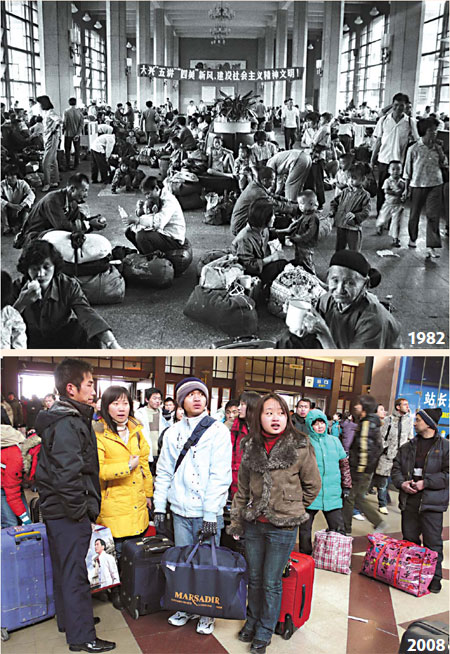 For the railway industry, some words and phrases essentially mean the same thing - be it development, modernization, reform or change. They all mean the job of carrying rural people into the cities - hundreds of thousands, time after time - to find new jobs, lives and homes.
Travel was costly and tiring. An average scene of the Beijing Railway Station, then the largest and most modern of the country (and still one of the largest), as in our 1982 black-and-white photo, shows no trace of the future trend. People from villagers and small cities just sat in ramshackle clusters on the lobby floor with simple luggage and home-made snacks. Despite the hanging propaganda banner to promote the so-called socialist spiritual civilization, some were sitting on the dirty floor littered with waste paper. Everybody was in a transient mood. They knew they were soon to go when the boarding whistle blew and this was not a place where they belonged. In fact, in 1982, the redistribution of collective farms to private management had yet to become a sweeping change. People were only beginning to make a little more income than the 1970s and could afford a few more colorful clothes. The phrase "market economy" was still taboo. Having millions of villagers leaving their farm jobs was something hardly anyone could have imagined. But as a result of the successful rural reform projects, first in Sichuan and Anhui provinces, then nationwide, the rise in farm productivity was able to raise a tremendous pool of labor for the industrial development in the cities. Nowadays, in many villages, farming is only reserved for the older people and providers of specialized services. All the young people (who would have been called "able-bodied farm workers") have gone to work in the cities, on fulltime or temporary contracts. In 2007, in an official survey, rural families reported at least 130 million of their members working on longer contracts in the cities - after some families had already entirely moved out of their old villages. The favorite destinations of many migrant workers are the large cities in the coastal and near-coast areas (such as Beijing). They want to stay in those cities. They want to be part of the modern China. Correspondingly, in the last 30 years, Beijing has built two more large railway stations - the Beijing West and Beijing South - with the one where our 1982 photo was taken still carrying the name Beijing Railway Station.
 (For more biz stories, please visit Industries)
|
主站蜘蛛池模板: 木里| 青河县| 泗阳县| 腾冲县| 乐昌市| 平陆县| 昭通市| 安徽省| 舟曲县| 阜南县| 蒲城县| 阜康市| 肃宁县| 宜州市| 南靖县| 团风县| 新晃| 台南市| 健康| 宜章县| 博客| 太和县| 旺苍县| 深州市| 平湖市| 黄冈市| 花莲市| 漯河市| 黑水县| 开封市| 云浮市| 舟山市| 晋中市| 阿合奇县| 深州市| 上思县| 北安市| 威海市| 雷山县| 泰州市| 苏尼特左旗| 鄂托克旗| 兴仁县| 定西市| 丰宁| 清原| 仁寿县| 临桂县| 海阳市| 台东市| 祁连县| 张家港市| 兴城市| 陆川县| 新蔡县| 武邑县| 鹤峰县| 凤山市| 滁州市| 蒲江县| 清水县| 东乌珠穆沁旗| 镇巴县| 巴里| 社旗县| 泸州市| 西安市| 密云县| 高雄市| 哈巴河县| 兖州市| 临沭县| 和顺县| 凯里市| 慈溪市| 桑植县| 仙居县| 安乡县| 鄂温| 平利县| 秦皇岛市| 开原市|



