BIZCHINA> Top Biz News

|
BIZCHINA> Top Biz News
|
|
Related
Nuke power capacity set to increase
By Si Tingting (China Daily)
Updated: 2009-02-04 07:42
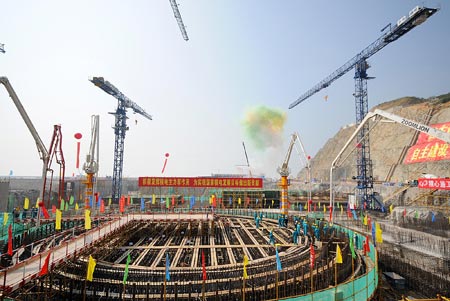
The country is poised to revise its energy development plans by nearly doubling its nuclear power capacity in the next decade, energy authorities have said. The revision is still awaiting approval from the State Council, the Chinese-language 21st Century Business Herald yesterday cited sources close to the National Energy Administration (NEA) as saying. There are currently 11 nuclear reactors in operation in the country with a combined capacity of about 9 gigawatts (GW), supplying more than 1 percent of the country's energy needs. NEA head Zhang Guobao last year said the country would raise the share of nuclear power in the national energy mix for 2020 from 4 percent, as set in 2006, to 5 percent. The target capacity for nuclear power was set at 40 GW by 2020. The latest energy revision aims for nuclear power to generate 70 GW for the country by 2020. The country would have to produce at least 60 GW of nuclear power to meet its 5 percent goal, the China Electricity Council (CEC) has said. "We have the ability to raise our nuclear power capacity to at least 60 GW 70 GW is not unthinkable," Fu Manchang, secretary-general of the Chinese Nuclear Society, told China Daily yesterday. The authorities would also "start building eight more nuclear power plants in the next three years, with 16 reactors whose total installed capacity will surpass 10 GW", the NEA sources were quoted as saying. Officials could not be immediately reached for comment on the specific locations of the new nuclear energy projects, but they may involve Sanmen of Zhejiang province, Yaogu in Guangdong province and Haiyang and Rongcheng in Shandong province, as indicated by Zhang.
The authorities will begin construction of nuclear power plants with a total capacity of 8.4 GW this year alone, State broadcaster China Central Television (CCTV) cited participants in a national energy conference held in Beijing yesterday as saying. The country will also invest 580 billion yuan ($84.8 billion) in the power industry this year and will accelerate its development of nuclear power plants and wind farms, CCTV reported. Oil reserves Similarly, China's four strategic oil reserve bases have reportedly begun operating and the country will start building eight more of such reserves this year, including those in Huangdao, Shandong province, and Jinzhou, Liaoning province. China currently relies on coal power plants to supply about 80 percent of its total energy needs. However, transporting coal can often be problematic, as shown by the damage sustained by the nation's railway system in snowstorms last year, Fu said. The authorities were then forced to shut many coal-fired power plants, leading to blackouts in many cities, he said. "China is in dire need of more nuclear power plants, especially in its southern provinces that are more economically developed but have a more acute need for local energy reserves," Fu said. The need to control carbon emissions also means the country has to increase its nuclear power generation, he said. "Third-generation nuclear power technologies, such as the AP1000 developed by the United States-based Westinghouse Electric Co, will be the main feature of our future nuclear power plants," Fu said. (For more biz stories, please visit Industries)
|
主站蜘蛛池模板: 定西市| 大渡口区| 香格里拉县| 赤壁市| 二连浩特市| 青河县| 赤城县| 亚东县| 安福县| 临夏县| 德清县| 延边| 彰武县| 邛崃市| 桑植县| 崇文区| 塔河县| 新竹市| 宣恩县| 和龙市| 祁门县| 白山市| 汤阴县| 克拉玛依市| 开远市| 彭州市| 大埔区| 赣榆县| 焉耆| 天峻县| 巴东县| 利川市| 黑水县| 奎屯市| 德保县| 财经| 邵阳市| 通辽市| 辛集市| 五华县| 信阳市| 南投县| 神农架林区| 东海县| 鹤壁市| 奎屯市| 江都市| 承德县| 清远市| 义乌市| 七台河市| 玛纳斯县| 邯郸县| 碌曲县| 东宁县| 佛教| 桂阳县| 南投县| 蒙阴县| 东至县| 乌兰浩特市| 白水县| 同心县| 宣武区| 清苑县| 敦化市| 连南| 天津市| 双峰县| 库伦旗| 双牌县| 玛纳斯县| 宁德市| 长葛市| 五家渠市| 河间市| 防城港市| 临西县| 江城| 夏津县| 洛隆县| 龙泉市|