BIZCHINA> Top Biz News

|
BIZCHINA> Top Biz News
|
|
CPI sign of economic 'recovery'
By Wang Xu (China Daily)
Updated: 2009-02-11 07:42
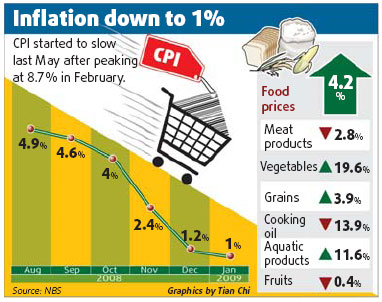
The consumer price index (CPI) in January rose only 1 percent year-on-year, the lowest in 30 months, and the other measure of inflation, the producer price index (PPI), dropped 3.3 percent.
The National Bureau of Statistics (NBS) released the figures yesterday. Inflation was a major concern at the beginning of last year. But the tightening of the monetary policy at the end of 2007 caused the CPI to start falling in May after it peaked at 8.7 percent in February last year. It fell to 1.2 percent in December, the lowest since July 2006.
The PPI dropped 1.1 percent in December after rising 2 percent in November and hitting a 12-year-high of 10.1 percent in August. The PPI's 3.3 percent decline was the steepest in eight years. Continuous massive loans from the State banks are likely to keep the CPI above zero in 2009, said Shan Weijian, Bank of Communications analyst. The PPI, however, could show a negative growth. Earlier this month, Premier Wen Jiabao said at the World Economic Forum in Davos that there were already signs of an economic recovery. Banks lent out 900 billion yuan ($131 billion) in the first 20 days of January, compared with 700 billion yuan in the same period in December and 400 billion yuan in November. The spending spree during Spring Festival pushed up food prices by 4.2 percent in January. But non-food products' prices, which comprise about two-thirds of the CPI basket, fell 0.6 percent year-on-year. "Both indicators show signs of deflation," Shan said. Food prices, a key contributor to CPI fluctuation, are not likely to increase substantially this year despite the worst drought in half a century, he added. Reports have said the drought is not likely to reduce grain production notably, while the bumper harvests of the past five years have created enough reserve to offset any shortfall in output. The lower PPI can be largely attributed to dropping commodity prices after the global financial crisis weakened demand and investment, the NBS said. For example, metal prices in January fell 41.4 percent year-on-year. "We have to see to what extent the global financial crisis worsens," central bank governor Zhou Xiaochuan said in Kuala Lumpur yesterday. Bloomberg reported that Zhou's remarks were in response to a question on whether China could face deflation. "Rapid disinflation (and deflation) is creating more room for further easing of the monetary policy," Morgan Stanley's Asia Pacific research team has said in a note. According to the team, China could cut the interest rate by 1.08 to 1.35 percentage points in the first half of this year. The central bank has cut the benchmark one-year lending rate by 2.16 percentage points to 5.31 percent since last year after the government decided to ease the monetary policy to bolster the economy. But some analysts cautioned against a rapid rise in inflation toward the end of this year because the government moves to relax lending and spur investment could help increase prices as the economy recovers. (For more biz stories, please visit Industries)
|
|||||
主站蜘蛛池模板: 阳春市| 苍梧县| 文昌市| 威海市| 英山县| 池州市| 二连浩特市| 尼木县| 松江区| 米易县| 泊头市| 内黄县| 榆树市| 新野县| 凤凰县| 翁源县| 张掖市| 定兴县| 嘉兴市| 温州市| 广平县| 长岛县| 丽水市| 宁都县| 岢岚县| 富顺县| 宁海县| 合江县| 九龙坡区| 时尚| 普兰店市| 荔浦县| 彰化市| 青阳县| 封丘县| 鄂温| 遵义市| 襄樊市| 西城区| 大邑县| 准格尔旗| 崇左市| 濮阳市| 威远县| 尖扎县| 嘉祥县| 基隆市| 浪卡子县| 思茅市| 吕梁市| 库伦旗| 邢台县| 正镶白旗| 蒙自县| 禹州市| 甘孜县| 简阳市| 辽中县| 溆浦县| 高雄市| 广平县| 启东市| 定南县| 峨眉山市| 昂仁县| 和龙市| 安溪县| 五莲县| 班戈县| 乳源| 镇安县| 邻水| 界首市| 尚志市| 宣威市| 阿瓦提县| 蓬莱市| 玉田县| 斗六市| 靖边县| 安化县| 田阳县|