BIZCHINA> Top Biz News

|
BIZCHINA> Top Biz News
|
|
Rail investment helps integration
By Lu Haoting (China Daily)
Updated: 2009-03-16 08:01
A railway triangle will soon take shape in the Yangtze River Delta area as groundwork on a high-speed passenger rail line between Shanghai and Hangzhou began in late February.
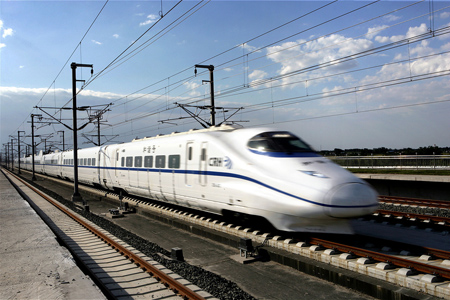
When the railway triangle involving the three lines is completed in 2011, passengers will be able to travel between any of the three cities within an hour. The current up-to-eight-hour slog from Hangzhou, capital of Zhejiang province, to Nanjing, capital of neighboring Jiangsu province, will no longer detour through Shanghai and will be only 50 minutes. "Regional economic integration must be supported by an efficient transportation network, especially rail lines," Chen Wei, a researcher with the Shanghai Academy of Social Sciences, told Xinhua. The high-speed railway between Shanghai and Hangzhou is expected to kick off before the 2010 World Expo in Shanghai. Trains will run up to 350 km an hour on the 159-km line and the travel time between the two cities will fall from over an hour to 38 minutes. Trains will run at three-minute intervals at rush hour. Shanghai and Hangzhou, are two of China's most economically affluent cities and fast economic growth in the Yangtze River Delta has generated huge demand for passenger and cargo transportation within the region. "Rail capacity in the Yangtze River Delta region has reached saturation point," Yu Jian'er, chairman of the Zhejiang Provincial Railway Investment Group Co Ltd, told Xinhua. He said cargo transport is often suspended to make way for passenger trains during peak travel seasons. The high-speed rail lines will cost 29.68 billion yuan. The Ministry of Railways will pay half of the construction costs. Caijing magazine reported that the Shanghai municipal government and the governments of regions of Zhejiang province that the new railways will pass through will contribute 40 percent and the rest will come from businesses. Baosteel Group, China's largest steelmaker, said earlier that it plans to invest 2 billion yuan in the Shanghai-Hangzhou high-speed railway and hold an 8 percent stake in the project. The 2-billion yuan deal is the Chinese steel industry's largest investment in a railway-building project. Caijing magazine reported that investors will set up a joint-stock company to carry out the project and will consider issuing corporate bonds to raise capital to cover construction costs. Yu said earlier that the Ministry of Railways will try to list the rail line on the stock market in the future. The line would be the third Chinese railway to go public after the Guangzhou-Shenzhen line in the south and the Datong-Qinhuangdao line in the north. The Shanghai-Hangzhou high-speed railway is the first project to begin construction since the State Council, China's cabinet, announced its economic stimulus package in November. The package focuses on infrastructure projects such as new railways, roads, airports, as well as rebuilding communities devastated by an earthquake in Sichuan last May. The country plans to double its investment in railways to about 600 billion yuan this year according to the Ministry of Railways. Part of the 600 billion yuan will go to building 5,148 km of new lines, including five passenger-only high-speed lines this year, Minister of Railways Liu Zhijun said late last year. The ministry also plans to start 70 other new projects this year, which will cost 1.5 trillion yuan by the time they are finished. The annual investment in railways between 2010 and 2012 will be no less than 600 billion yuan, the ministry said. By 2012 China will have 110,000 km of rail lines, 13,000 km of them passenger routes. Many will be high-speed networks allowing trains to run between 200 and 350 km an hour.
(For more biz stories, please visit Industries)
|
||||||
主站蜘蛛池模板: 甘孜县| 徐水县| 深泽县| 宿迁市| 长垣县| 海南省| 平顶山市| 勐海县| 阜新| 蓝田县| 新建县| 安康市| 潮安县| 肃宁县| 广昌县| 广河县| 镇安县| 南岸区| 新建县| 清河县| 松潘县| 平利县| 汕尾市| 祁阳县| 昆山市| 西吉县| 莲花县| 永胜县| 汕头市| 厦门市| 四会市| 沈阳市| 简阳市| 衡阳市| 南平市| 罗山县| 德江县| 嘉祥县| 鄂托克前旗| 得荣县| 中卫市| 福州市| 华阴市| 囊谦县| 阿拉善盟| 观塘区| 瑞安市| 大化| 铁岭县| 游戏| 长丰县| 天水市| 环江| 芷江| 炉霍县| 郎溪县| 临西县| 务川| 济宁市| 观塘区| 兴文县| 岢岚县| 古田县| 庄浪县| 望谟县| 元氏县| 台山市| 泰和县| 公主岭市| 湘乡市| 济南市| 金门县| 大荔县| 肥西县| 铜梁县| 闸北区| 和硕县| 永新县| 牡丹江市| 望江县| 新兴县| 盐亭县|