BIZCHINA> Top Biz News

|
BIZCHINA> Top Biz News
|
|
McKinsey: More rich in China by 2015
By Ding Qingfen (China Daily)
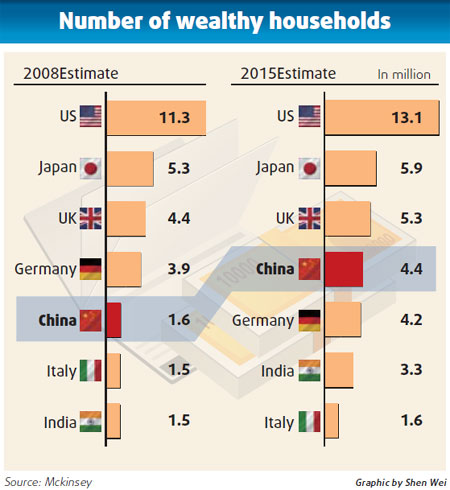
Updated: 2009-04-03 07:56 The global economic recession is forcing the rich in China to scale down their spending on luxury goods, but it cannot hold back the rapid growth of wealthy households, according to a report released yesterday by global management consultancy McKinsey & Company. China is expected to be the world's fourth largest country with wealthy households by 2015, after the US, Japan and the UK. The nation is expected to have more than 4 million wealthy households by then, the report said. The time is right for international luxury companies to invest in China and cash in on the tremendous opportunities over the next five to seven years, despite the negative short-term impact of the financial crisis, the report said. The McKinsey research was conducted in the last quarter of 2008 and was based on face-to-face interviews with 1,750 wealthy households from China's 16 cities. The wealthy households, as McKinsey identifies, refer to those having an annual income in excess of 250,000 yuan. By the end of last year, there were 1.6 million wealthy households nationwide, accounting for less than 1 percent of the total, but the tally will increase by 16 percent annually.
"It's very important for luxury brands to take a quick step in developing the second-tier market," said Vinay Dixit, senior director, McKinsey Asia Consumer Centers. The most striking finding, according to McKinsey, is that the Chinese wealthy are much younger than those from the US and Japan, with about 80 percent under 45, compared with 30 percent in the US and 19 percent in Japan. They are usually much better educated than other Chinese consumers and most of them are self-employed. "The products or services that the global players provide here need to fit younger Chinese wealthy consumers, while keeping a consistent global brand positioning," said Dixit. Of the 1.6 million wealthy households, about 50 percent were not rich four years ago, and McKinsey predicted that more than half of those that will be wealthy by 2015 are yet not today. Over 55 percent of the people surveyed said they had started to use luxury products four years ago. This is a positive signal. "The consumer expectations on luxury goods are still evolving. Companies have greater flexibility to shape consumer perception and behavior," said Yuval Atsmon, an associate principal from McKinsey Shanghai. Compared with the common Chinese consumers, the wealthy consumers are keen on buying foreign brands and hi-tech gadgets, and they are willing to pay a premium for high quality products.
(For more biz stories, please visit Industries)
|
|||||
主站蜘蛛池模板: 专栏| 绥江县| 泸定县| 五台县| 安泽县| 奇台县| 八宿县| 普陀区| 株洲市| 赫章县| 罗平县| 那曲县| 黄陵县| 淳化县| 宝鸡市| 潜江市| 江阴市| 娄底市| 双城市| 福泉市| 乌拉特后旗| 镇远县| 大兴区| 辉南县| 海南省| 钦州市| 汝州市| 莱芜市| 新安县| 包头市| 龙南县| 屏东县| 郧西县| 怀安县| 香格里拉县| 阳朔县| 屏东县| 黄冈市| 蓝田县| 锡林浩特市| 景德镇市| 日照市| 建始县| 黎川县| 伊川县| 老河口市| 赞皇县| 上思县| 胶南市| 林芝县| 邯郸市| 武陟县| 洛浦县| 嘉荫县| 晋城| 酒泉市| 沂源县| 平陆县| 和政县| 石河子市| 囊谦县| 花垣县| 汕尾市| 镇沅| 东明县| 河西区| 本溪市| 万年县| 巴东县| 凉山| 资兴市| 堆龙德庆县| 葵青区| 江孜县| 镇安县| 宾阳县| 罗定市| 青田县| 景东| 成安县| 崇州市| 香河县|



