BIZCHINA> Top Biz News

|
BIZCHINA> Top Biz News
|
|
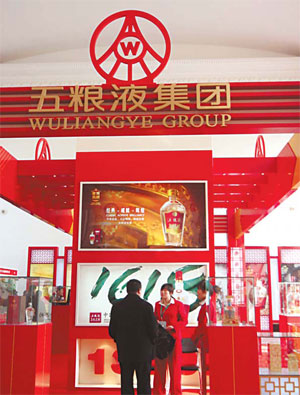
Wuliangye fights to stay high
By Ding Qingfen (China Daily)
Updated: 2009-04-08 08:01 Wuliangye Yibin may be the biggest wine producer in the rapidly expanding Chinese liquor market, but to investors, it is coming across as a fumbling giant trying to defend its territory against more nimble competitors like Kweichow Moutai. Analysts who track the liquor industry have attributed Wuliangye's problem to its close relationship with parent company, Wuliangye Group, and various inter-group affiliates. Although Wuliangye's output volume, at 90,000 tons in 2008, was three times that of Moutai's, it trailed behind its archrival in both sales and profit. Moutai's sales, at 8.24 billion yuan in 2008, were 310 million yuan higher than Wuliangye's. And its profit, at 5.39 billion yuan, was nearly double that of its much bigger rival. There was even greater disparity in both companies' earnings per share. Moutai's EPS was 4.03 yuan for 2008, about eight times more than that of Wuliangye's.
As for brand value, while both firms enjoy instant recognition in the high-end segment of the market place, Moutai's popularity far exceeds that of Wuliangye's at the bourses, analysts said. At current share prices, Moutai has a market capitalization that is twice as large as Wuliangye's. Interestingly, when Moutai listed in 2001, its market capitalization was only half of that of Wuliangye's, which listed in 1998. Stock analysts said Wuliangye's problems center around the company's management system wherein executives who have dual responsibilities fill key positions at both itself and its parent. "The company's unreasonable management system is its worst enemy," Teng Wenfei, a beverage analyst at Shanghai Securities, told China Daily. Indeed, nearly all the high-level executives at Wuliangye also occupy important posts in Wuliangye Group. As the Wuliangye 2008 financial report showed, the majority of the 20 members of Wuliangye's management committee, including its chairman and executive directors, had executive roles at Wuliangye Group as well. What's more, their annual bonuses are mainly based on their performances and achievements at the parent company, not the wine making unit, as per the policy of the Yibin State-owned Assets Supervision and Administration Commission, which holds 100 percent share in Wuliangye Group.
As a result, the Wuliangye management has little motivation to sharpen competitiveness in the listed company and its priority is on growing the group's financial figures. That is the reason why there are a lot of affiliate transactions between the two and large volumes of cash flowing out from Wuliangye to the parent company. In 2008, the affiliate transactions involved cash worth around 6 billion yuan, accounting for 76 percent of Wuliangye's sales revenue during the same period. "Wuliangye would not regain its power unless the affiliate transactions are cut off," said Teng. And, since the management team has been sparing most of its energy and efforts on improving the group, Wuliangye's own strategy has been unclear over the past decade, analysts said. From 1998 to 2003, the company was aggressively expanding, even growing its brands to more than 200 in the high-, mid- and low-end categories. The huge investment and thin profitability in the low-end sector squeezed Wuliangye's profit margin hard. Even now, there are still 50-odd brands under Wuliangye, among which over 60 percent are low-end brands. In 2008, the low- and mid-end contributed to sales of 1.88 billion from a total of 7.93 billion. The net profitability from this segment was 16.65 percent, much lower than the 66.73 percent from sales of its high-end brands. In contrast, Moutai has been following a high-end strategy. Each year, the high-end sector contributes more than 90 percent to its sales. Its corporate profit ratio for 2008 was 65.4 percent, while it was merely 30 percent for Wuliangye. Over 50 percent of Moutai's sales are generated from government institutions, organizations and corporate clients who are the target consumers of high-end liquor and are less sensitive about pricing. Caught napping, Wuliangye is now gearing up to revise its strategy in a bid to gain an upper hand. In its 2008 annual report, the company said it would target the mid- and high-end sectors this year and said it would try to increase the ratio of these segments among its portfolio. Wuliangye has also decided to reduce affiliate transactions. Early this year, the company finished acquiring part of the assets of the Wuliangye Group, which had led to inter-group transactions worth 1.8 billion to 2 billion yuan in 2008. Wuliangye is also thinking of acquiring the rest of the assets, which includes an import and export firm under the Wuliangye Group. Although the company has not given any timeframe for the completion of the deal, insiders predict it would be completed in three years. Wuliangye, however, will not find it easy to think out of the box. The high-end liquor market has been sluggish since the financial crisis. Other players too are trying hard to catch up. The scorching growth in the Chinese liquor market began to simmer from the last quarter of 2008. From October to December, liquor sales grew by only 14 percent, which brought down the whole year growth to 15.8 percent from 22.2 percent in 2007. "The market, especially the high-end sector, cannot recover until the third quarter of this year," Teng said. (For more biz stories, please visit Industries)
|
||||||
主站蜘蛛池模板: 巫山县| 安丘市| 同心县| 平泉县| 通榆县| 凌源市| 敖汉旗| 宁陕县| 紫金县| 韶山市| 济阳县| 普兰县| 滕州市| 莱阳市| 外汇| 乌什县| 大足县| 温州市| 兖州市| 宽城| 淳安县| 逊克县| 龙陵县| 新泰市| 玉门市| 延长县| 霍州市| 鄂托克旗| 潜江市| 新余市| 宁安市| 廊坊市| 皋兰县| 绵阳市| 曲阜市| 河北区| 武陟县| 温宿县| 古丈县| 大理市| 密云县| 金山区| 东兰县| 仲巴县| 孟州市| 宁晋县| 闵行区| 盐池县| 富蕴县| 鄯善县| 霞浦县| 宝山区| 祁阳县| 正镶白旗| 如皋市| 山阴县| 湖南省| 桦甸市| 宜州市| 沽源县| 武夷山市| 仁化县| 临泉县| 兴山县| 仙游县| 日照市| 固镇县| 滨海县| 勐海县| 三江| 新化县| 深州市| 尉氏县| 安图县| 临泉县| 三江| 盐山县| 瓦房店市| 云霄县| 巢湖市| 阜宁县| 崇义县|