BIZCHINA> Top Biz News

|
BIZCHINA> Top Biz News
|
|
Getting wind of the future's energy needs
By Sun Xiaohua (China Daily)
Updated: 2009-05-04 07:49
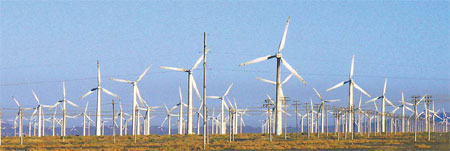
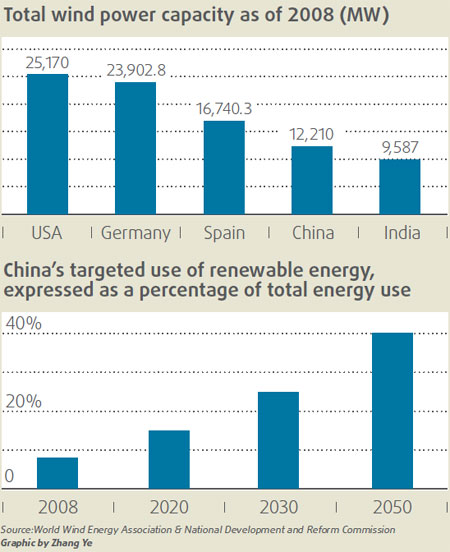 China has set a target for renewable energy consumption of 40 percent of the market by the year 2050. The news comes as it emerges that China will have 100 GW of wind power capacity by 2020, more than three times the 30 GW the government set as a target 18 months ago. It's also been revealed that China will become the biggest growth market for wind power generating capacity this year, ahead of the United States, which has been worse-hit by the economic downturn, according to the Global Wind Energy Council (GWEC).
The annual growth rate in wind power in China will be about 20 percent, Fang Junshi, head of the coal department of the National Energy Administration, told a Coaltrans conference in Beijing. China, the world's second largest energy user, has around 12 GW of wind power capacity and has said it wants to raise that to around 20 GW by next year. That means wind is set to be a bigger source of power than nuclear, despite a construction boom in nuclear power plants, and far bigger than solar, which is expected to hit 1.8 GW by 2020, according to a 2007 plan. More than 27 GW of wind power generating plants worth about $53 billion were built around the world last year. Demand for power in China has been spurred by economic stimulus measures. "China is powering ahead with no visible signs of slowing down," said Steve Sawyer of the Brussels-based GWEC. "If anything it is accelerating. They intend to become the largest market in the world, very clearly, and they probably will unless things take off in the US again in the relatively near term."
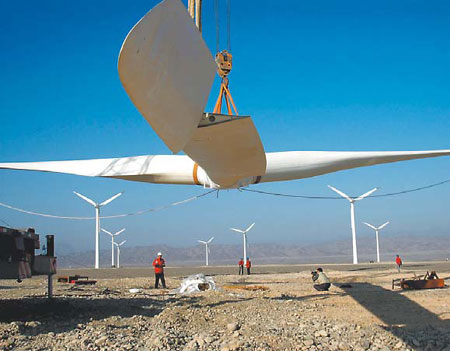
China's local wind turbine manufacturing industry has "grown dramatically" as power production has expanded, Sawyer said. Local manufacturers, dominated by Sinovel Wind Co, Xinjiang Goldwind Science & Technology Co and Dongfang Electric Corp, captured more than half the domestic market for the first time in 2007, rising to between 75 percent and 80 percent last year. "Although all the big international brands are there and their markets are growing in absolute terms, their market share is diminishing pretty rapidly," Sawyer said. The growth in Chinese wind turbine manufacturing means Chinese-made equipment is poised to emerge in the international wind market "in earnest", Sawyer said. Until now, Chinese suppliers have only won smaller contracts in the US, Cuba, Peru, Africa and the Middle East, he said. Danish company Vestas, the world's largest wind turbine maker, plans to invest $9 million in its factory in Inner Mongolia to produce about 800 sets of V60-turbines every year. These turbines are specially tailored for Inner Mongolia's low to medium strength winds, being shorter with bigger blades than standard turbines. The factory will employ an additional 1,000 Chinese people, about half of its current local employees. The company, which entered the Chinese market in 1986, has a market share of about 12 percent. This pales in comparison with local competitors such as Sinovel, Goldwind and DEC, which took about 65 percent of market share in 2008, according to Shi Pengfei, vice-president of the China Wind Energy Association.
The World Wind Energy Report 2008 predicts that Asia, under China's lead, will "become the worldwide locomotive for the wind industry" and "Chinese wind turbine manufacturers will be among the top international suppliers". Wang Jun, director of the National Energy Administration's renewable energy department, said: "Renewable energy will become the mainstream power supply in 2050 from a supplementary role in 2010." He envisaged a future with heating dependent on solar and geothermal power, cars driven using biofuels and families owning their own photovoltaic power stations, turning the country from the world's biggest emitter of greenhouse gases to one of its smallest. However, some are worried that too much attention and aid is being paid to the renewable energy industry. They argue China should focus on clean coal technology. "Renewable energy is our destiny, but it is not the solution to China's urgent problem of large-scale coal burning," said Feng Xiaoting, director of Jiangsu Coal Chemical Engineering Institute. He said he believes that in the next 30 to 40 years, traditional energy, especially coal, will still be the powerhouse for China's growth. He said clean coal technology research and development should be prioritized. (For more biz stories, please visit Industries)
|
|||||||
主站蜘蛛池模板: 富宁县| 渝北区| 峨眉山市| 苍南县| 碌曲县| 德惠市| 加查县| 温宿县| 潼关县| 康定县| 惠安县| 如东县| 托克逊县| 毕节市| 连江县| 榆林市| 达拉特旗| 台江县| 中西区| 兴隆县| 赤城县| 大田县| 福安市| 道孚县| 海城市| 小金县| 铁岭市| 青海省| 来安县| 乳源| 集安市| 永城市| 弥渡县| 来安县| 石门县| 仪陇县| 望都县| 星座| 沂南县| 辽阳县| 莒南县| 灵川县| 通化市| 田阳县| 安吉县| 峡江县| 田东县| 施秉县| 长丰县| 越西县| 从江县| 荃湾区| 炉霍县| 宣恩县| 濮阳市| 安新县| 九寨沟县| 深圳市| 余庆县| 沂南县| 河西区| 调兵山市| 景泰县| 小金县| 林甸县| 连云港市| 肥城市| 平度市| 东山县| 明星| 南部县| 加查县| 本溪市| 罗城| 澄迈县| 克什克腾旗| 九台市| 湘西| 河曲县| 云梦县| 金门县| 习水县|