BIZCHINA> Top Biz News

|
BIZCHINA> Top Biz News
|
|
The power of the sun
By Li Xiang (China Daily)
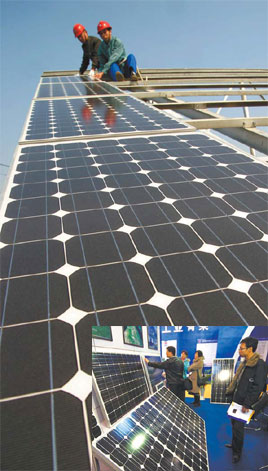
Updated: 2009-05-04 07:49 Zhao Chunjiang paid a high price to save about 3 tons of coal from being burned with their consequent 9 tons of carbon dioxide emissions over the past two years. The 55-year-old college professor and a solar energy enthusiast in Shanghai did that by building China's first family power generator plant, using 22 solar panels installed on the roof of his apartment.
Zhao paid $23,800 for his household generator, a price out of the reach of ordinary families in China. And because the Chinese government has no policy on purchasing electricity generated by renewable energy from a family's personal power plant, Zhao had to actually pay the local utility company to feed surplus electricity into the city's grid. The cost of generating electricity from solar energy has dropped significantly over the past two years because the price of polysilicon, the main material used in producing solar cells, has plummeted to record lows amid the global economic downturn. Polysilicon is now traded at about $30 to $40 a kg, down from the peak of $400 a kg last July. "Now you can build a system like this for only half the money," said Zhao, who believes solar energy in China has a bright future.
What is more encouraging is the support from the government. The Ministry of Finance recently announced new subsidies for domestic solar projects, hoping to stimulate the home market because the export-led solar industry was hard hit by the sluggish demand from American and European markets. The government will grant $2.93 a watt for solar projects with a generating capacity of at least 50 kW, according to the ministry's statement. Chinese solar stocks jumped after the announcement. China's leading solar companies such as Suntech Power Holdings will be the biggest beneficiaries from the new subsidies. The current cost of solar power is about four to five times the alternatives such as wind power or electricity produced from coal. But with the price of raw materials further declining and more favorable subsidies being offered, the cost has now dropped to $0.26 per kWh for some large solar companies, which is about three times the cost of electricity from coal. Experts estimate that if the trend continues the industry will see costs cut further to as little as $0.15 per kWh. High costs and limited government subsidies were the major hurdles that held back the development of solar energy in China. Last year, China produced a quarter of the world's solar photovoltaic (PV) cells, surpassing Germany and Japan as the world's biggest producer of solar cells. But only less than 3 percent of those cells were bought in China. China's installation of PV solar capacity is also meagre, having about 150 MG by the end of last year, which accounts for only 0.8 percent of the world's total capacity. The insufficiently stimulated home market has made the Chinese solar industry heavily dependent on overseas markets. As much as 98 percent of Chinese solar cells are sold in overseas markets. "The recent government subsidies on solar projects will help shift the focus back to the domestic market and will effectively promote the development of solar industry at home," said Lu Yanwu, deputy manager of Rijia Electric Company in Beijing. China's demand for energy is surging with the country seeing double-digit economic growth in the past decade. So far China derives 75 percent of energy from coal. To combat energy shortages and environmental degradation, the Chinese government has taken steps to boost renewable energy usage to fuel its booming economy. The National Development and Reform Commission (NDRC), China's top economic planner, has set the goal of increasing the usage of renewable energy to 10 percent of total energy consumption by 2010 from the current 7.5 percent. By 2020, China will develop 1.8 GW of solar photovoltaic power, according to the NDRC. The forecast is that by that time, more than $40 billion will be invested in the solar sector, accounting for 16 percent of the total renewable energy investment in China. There is also a vast market potential in China's ambitious program of providing electricity to more than 20 million Chinese in more than 20,000 rural villages by 2010. The program will bring lucrative business opportunities for domestic producers of solar PV cells. The construction of two MW-level solar power plants in Shanghai's Chongming island and in the Inner Mongolia autonomous region has recently been completed. They receive government subsidies of $0.59 per kWh. To speed up the development of solar energy, China also plans to build a 1GW grid-connected solar PV power plant in Qaidam Basin, Qinghai province. It will be the world's largest when it is completed. In the meantime, thin-film solar cells are being developed as a strong substitute for traditional solar cells to avoid the downside of polysilicon production that could cause pollution to the environment. The Washington Post reported that some Chinese solar companies were dumping the toxic byproduct of polysilicon production - silicon tetrachloride, a highly toxic substance that poses environmental hazards. Experts said the thin-film solar cells doesn't rely on the polysilicon raw material and if the project has a breakthrough in its current electricity conversion rate, it will have the positive prospect of further reducing the cost and the environmental risks. (For more biz stories, please visit Industries)
|
||||||
主站蜘蛛池模板: 三河市| 突泉县| 鄂伦春自治旗| 赣榆县| 贞丰县| 井研县| 重庆市| 巴塘县| 北安市| 衡阳市| 白山市| 昌吉市| 石楼县| 福清市| 文登市| 陇川县| 牙克石市| 尼木县| 科技| 南涧| 龙胜| 普兰县| 浙江省| 咸丰县| 黔东| 澄江县| 赤城县| 磐石市| 长白| 西青区| 望江县| 石棉县| 郯城县| 松阳县| 饶阳县| 酉阳| 寿宁县| 威宁| 浦江县| 油尖旺区| 辛集市| 满洲里市| 曲麻莱县| 汝阳县| 新泰市| 辛集市| 闻喜县| 资源县| 彩票| 桐梓县| 顺义区| 贵州省| 玉山县| 古蔺县| 莆田市| 沛县| 色达县| 巫山县| 蓝田县| 白沙| 乌鲁木齐县| 江津市| 五大连池市| 新蔡县| 容城县| 绿春县| 广州市| 衡阳市| 肥西县| 牡丹江市| 白沙| 普格县| 辰溪县| 龙门县| 玉门市| 资中县| 奈曼旗| 子洲县| 微博| 肇源县| 蒙阴县| 界首市|