BIZCHINA> Top Biz News

|
BIZCHINA> Top Biz News
|
|
Yangtze's ecological imbalance
By Li Jing (China Daily)
Updated: 2009-05-25 08:00
The specimen of two endangered fish in the Yangtze River, the Chinese sturgeon and the Chinese paddlefish, look misplaced in a room responding with the history and successes of the Three Gorges hydro project. Just a few meters away, at the Three Gorges Exhibition Center, in Hubei's Yichang city, stands a model of one of the 26 water wheel generators installed at the dam, used to generate electricity. The hydro project, which began construction in 1993, includes a 185-meter-high dam, a five-tier ship lock and 26 hydro powered turbo-generators, with six more underground generators to be installed by 2012. The dam was built to help stop flooding in the rainy season and relieve droughts in downstream province, during the dry season. It was also built to generate clean electricity and enhance the river's shipping capacity. The dam has succeeded in many respects.
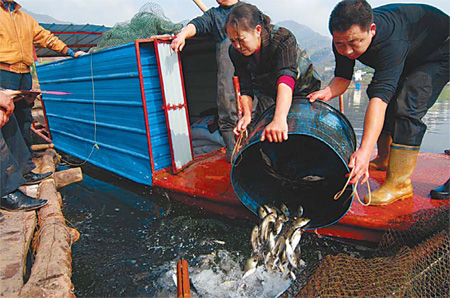
It reached 156 m in 2006 and exceeded 172 m in 2008, close to its maximum planned height of 175 m. This increase of water levels in reservoir areas behind the dam has raised concerns about environmental and ecological risk in recent years. A recent report published by the Chinese Academy of Sciences (CAS) found that the water quality in the Three Gorges reservoir area is worsening. In the surrounding area, the wetlands' ecosystems are deteriorating with the loss of fishing resources and biodiversity in the Yangtze. Based on continuous monitoring of the project's impact on environment and ecology since 1996, the report concluded that although the overall water quality remained normal, the tributaries of upper Yangtze in the reservoir areas have recorded a hike in the concentration of nitrogen and phosphorus since 2003, the year water storage began. Frequent outbreaks of algae, as a result of excessive nutrients in the water, have also been recorded in the Yangtze tributaries in reservoir areas, where slow running water is conducive to the growth of algae. "The occurrence of algae outbreaks has many reasons," Tong Chongde, a spokesman at Three Gorges Office under the State Council told China Business Weekly. "Increased pollution discharges from industrial projects in reservoir areas and increased shipping activities along the Yangtze have contributed to the accumulation of nutrients, such as nitrogen and phosphorus," said Tong. Even though the most stringent environmental standards have been adopted in reservoir areas and a lot of money has been spent building sewage treatment and waste disposal plants, pollution emissions are still rising as a result of urban and industrial development in the reservoir areas, according to Tong. Pollutants, which were originally in the soil, have dissolved into the water with the rising level of water, thus worsening of water quality, according to the report. The Three Gorges dam and other hydro projects, are said to be disrupting migration routes of some fish species, changing the ecology of fish spawning sites. The Chinese sturgeon, a unique species that has been living in the Yangtze River for more than 140 million years, usually swam upstream -- from the East China Sea to the Jinsha river, the upper reaches of the Yangtze - to spawn. This migration route was blocked by the Gezhouba dam, built in the 1980s. This was the Yangtze's first hydro project, located about 38 km downstream from the Three Gorges dam. A researcher with Chinese Sturgeon Institution in Yichang told China Business Weekly that in the 1980s, a special conservation area was established below the Gezhouba dam for the sturgeon and fish even started laying eggs there. "But ever since water storing for the Three Gorges dam started in 2003, there has been a steady drop in egg laying and migration activities. This is possibly because of the changing aquatic environment," said the researcher. "Now only about 10 sturgeons come back to lay eggs every year," said the researcher, "it used to be several hundred before the dams were built." Many other common freshwater fish have also decreased due to the changes in their aquatic environment. The four major species of freshwater fish - black carp, grass carp, silver carp and crucian carp - have also seen a steady decrease, with a shrinking scale of spawning since 2003, according to the CAS report. Confronted with the mounting environmental and ecological risks, the Three Gorges Office has been working on an overall plan to solve the problems caused by the project, Tong said. The plan, which will be submitted for review by the State Council in November, will be implemented between 2010 and 2020. "The government will continue to provide fund to minimize the negative impacts of such a giant project, while maximizing its benefits," said Tong.
(For more biz stories, please visit Industries)
|
||||||
主站蜘蛛池模板: 韩城市| 三明市| 洛阳市| 兖州市| 阳曲县| 桃源县| 南宫市| 乌苏市| 成都市| 遂昌县| 安远县| 罗山县| 山丹县| 古丈县| 敦化市| 河曲县| 西青区| 化隆| 荆门市| 安庆市| 抚顺市| 沂南县| 霍林郭勒市| 卢龙县| 锦屏县| 内江市| 古浪县| 潍坊市| 东方市| 辽阳市| 彩票| 贵州省| 柳州市| 靖安县| 垣曲县| 佛教| 承德市| 雅安市| 武宁县| 龙胜| 潞西市| 鄂托克前旗| 虹口区| 庆阳市| 高安市| 英吉沙县| 垦利县| 屏山县| 岳池县| 孟村| 延边| 泽州县| 永济市| 定结县| 张北县| 临颍县| 开原市| 泾源县| 广昌县| 汕头市| 文化| 勃利县| 吉隆县| 贵南县| 百色市| 皮山县| 朔州市| 定西市| 讷河市| 清涧县| 新建县| 娄烦县| 县级市| 横峰县| 阳山县| 新竹市| 眉山市| 正蓝旗| 福建省| 吉首市| 永靖县| 康定县|