BIZCHINA> Top Biz News

|
BIZCHINA> Top Biz News
|
|
Hoteliers from smaller cities gain from stimulus moves
By Ding Qingfen (China Daily)
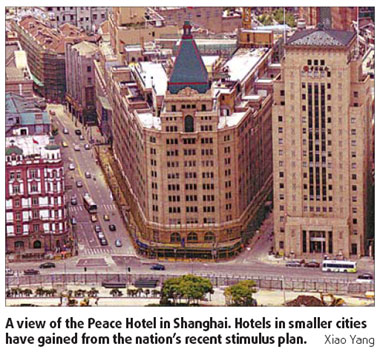
Updated: 2009-07-18 08:10 Hoteliers in secondary cities are benefiting more from China's stimulus measures, with larger markets in Beijing and Shanghai weighed down by past construction booms, said Jones Lang LaSalle Hotels on Friday. Tier-two and tier-three cities are benefiting from massive infrastructure spending, while the massive hotel expansion ahead of the 2008 Olympics saturated the Beijing market, said Andreas Flaig, Beijing-based managing director at the consultancy, a unit of Jones Lang LaSalle. From 2006 to 2008, the number of hotel rooms doubled in Beijing and will grow another 23 percent through 2011, said Flaig. That build-out has pushed occupancy rates in Beijing down to 47 percent for five-star hotels, and 50 percent in the four-star market. "Once you drop below 50 percent occupancy, then you start to seriously impact the profitability of a hotel," said Flaig. "We are way off the 75 occupancy the city has enjoyed before."
But the economies in secondary cities such as Sanya, Dalian and Hangzhou are still growing around 15 percent, buoyed by domestic demand, central government stimulus measures and a lower reliance on export industries, he said. "It is a reflection of the government stimulus and banks pumping in trillions of yuan," said Flaig. "Therefore, buying land to start new projects is easier now than six or nine months ago." Despite high expectations of post-Olympics demand, China's hotel sector was hit badly by the global economic crisis in 2008. Ten out of the 13 cities that the firm interviewed witnessed a decline in revenue per available room (RevPAR). In the five-star sector, occupancy rates for Beijing and Shanghai dropped by 7.2 and 10.4 percent from a year earlier to 60.7 and 56.3 percent. Occupancy rate of four-star hotels in the two cities fell by 13.4 and 8.5 percent to 60.9 and 59 percent. "The anticipated post-Olympic demand was hit badly by the economic crisis," said Lily Ng, senior vice-president, of Jones Lang LaSalle Hotels China.
That also explains why the second- and third-tier cities have outperformed Beijing and Shanghai. In 2008, the five-star RevPAR for cities and municipalities including Qingdao, Chengdu, Chongqing, Dalian, Xi'an and Shenyang rose by 37, 10, 14.4, 12.8, 16 and 1 percent, while it dropped by 7 and 3.4 percent for Beijing and Shanghai. Though the new room growth in Shanghai was just 17 percent last year, the city is expected to see a surge of nearly 47 percent over the next three years. "The supply has grown too much, but the demand has not kept pace," Flaig said. Compared with mature markets, China has enough luxury hotels at the moment, but it lacks mid-level hotels especially three- and four-star ones and this is where the opportunities are for hoteliers, he said. Reuters contributed to this story (For more biz stories, please visit Industries)
|
主站蜘蛛池模板: 榆社县| 土默特右旗| 道真| 浦东新区| 平舆县| 德州市| 乳山市| 武功县| 诏安县| 秦皇岛市| 宁陵县| 清远市| 平顶山市| 汨罗市| 商水县| 远安县| 平阴县| 乐安县| 永福县| 洛阳市| 台北县| 博罗县| 稻城县| 鄂托克前旗| 河曲县| 莎车县| 乌审旗| 彰武县| 肥东县| 濮阳市| 广汉市| 正阳县| 安义县| 和林格尔县| 韶山市| 新邵县| 晋江市| 永宁县| 广宁县| 昌吉市| 汤原县| 监利县| 沧州市| 莲花县| 牡丹江市| 祁阳县| 通山县| 客服| 会理县| 陆川县| 商水县| 嫩江县| 通化市| 仁布县| 章丘市| 西青区| 十堰市| 循化| 中宁县| 项城市| 马边| 浦东新区| 达孜县| 汉阴县| 峨眉山市| 隆尧县| 博野县| 盐亭县| 德庆县| 河北省| 东兴市| 南郑县| 修文县| 贵阳市| 南平市| 新泰市| 安化县| 南阳市| 攀枝花市| 遂宁市| 台山市| 龙南县|