BIZCHINA> Editor Choice

|
BIZCHINA> Editor Choice
|
|
Dangers of keeping workers in the dark
By Fu Jing and Wang Huazhong (China Daily)
Updated: 2009-08-06 07:47
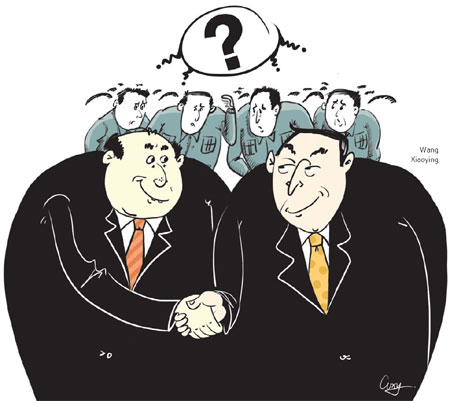 As workers passed through the gates of the Tonghua Iron and Steel Group yesterday, there was little evidence of the violence that erupted 13 days ago, leading to the death of an executive. It seemed a vision of normality, but the true scars of the shocking events of July 24, when around 1,000 people launched a 10-hour riot after being told of possible mass layoffs, run deep in this industrial city. Chen Guojun, 40, vice president of the privately owned Jianlong Heavy Machinery Group in Beijing, had gone to Tonghua in Northeast China's Jilin province to inform staff at the city's largest employer about an agreed takeover deal. He addressed them shortly before noon and by 11 pm that night he was dead - beaten to death by a gang of disgruntled workers.
A police taskforce has been set up to investigate who dealt the fatal blows but eyewitnesses claimed protesters attempted to halt the plant's production lines before Chen, who was expected to become general manager of a joint venture, reportedly told rioters: "If you do not kill me today, I promise you will not even get a bowl of vegetable soup to drink." He then fled to a workers' dormitory where he was discovered by a gang of protestors and brutally attacked. He died later in hospital. Since Chen's death, officials from Tonghua Iron and Steel, Jianlong Heavy Machinery and the local government have refused to comment. Only one media conference has been staged, organized three days later by the provincial State-owned assets supervision and administration commission. Police have also refused to disclose any information related to the investigation or if any suspects have been detained. The lack of transparency has led many experts to question the cause of the tragedy, including Zhong, a veteran mergers and acquisitions researcher for the State Council Development Research Center, a central government think-tank. "Police should look at who was possibly hidden behind this bloodshed," said Zhong, who gave only his surname. He has urged police to investigate Tonghua's five-member senior management team, who would have all likely been ousted had the takeover been completed. "The team possesses about 1 percent of the firm's share-holding rights," said the expert, who has been involved in helping streamline China's policing of State-owned enterprises (SOEs) since the early 1990s. "That might not be a huge amount, but it meant a lot if the Tonghua-Jianlong merger did not go ahead. It makes them key decision makers and they would not have wanted to lose their jobs. "Police should look at whether they plotted the violence. At the very least, they should be questioned whether they turned a blind eye when it went from a protest to a riot." Eyewitness accounts appear to dispel this theory, however, with many at the scene agreeing the initial demonstration was started voluntarily. Zhong is not so sure. He has been involved in several cases when private firms have taken over money-losing SOEs and said they can be fraught with tension if not handled correctly. "Conflicts between the management team of the SOE and the private company are not uncommon, while SOE bosses sometimes plot protests or incidents to stall deals," he added. "Thankfully the number of incidents is decreasing as most SOEs have already been bought up or accomplished ownership reforms." Just 5 percent of all firms in China today are State-owned, according to the State Administration for Industry and Commerce. In 1978, at the start of the nation's reform and opening up, it was almost 99 percent. Companies that deal with the Tonghua steelworks as part of its "business chain" in Jilin could also come under scrutiny after experts claimed some were illegally reaping profits from the State-owned firm. Residents claimed nearby factories stole iron and steel supplies from the plant and then sold it back to them. They also stressed the company provided thousands of local families, either of employees or scrap metal dealers, guaranteed "rice bowls", or basic life necessities.
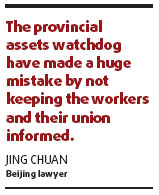
Eyewitnesses said many of the protesters, who were not wearing workers' uniforms, swamped the steel plant and threw plastic bottles. The violence escalated soon after. "These people may have been sent to stir up trouble by those illegal businesses in the chain," added Yang. Jing Chuan, a lawyer for Gaodong Law Firm in Beijing, has supported calls for a full inquiry into whether the steel company, local government and police failed to act swiftly enough to prevent the tragedy. "Why did this incident end with a death? Did all parties do everything they could to ease the tension? Did they fulfill their duties? The authorities should have had people trained and ready to respond to such a mass incident," he said. (For more biz stories, please visit Industries)
|
||||
主站蜘蛛池模板: 商城县| 阳谷县| 宜兰县| 普陀区| 丰顺县| 安多县| 赤峰市| 偏关县| 巨鹿县| 古丈县| 崇文区| 独山县| 南岸区| 方山县| 曲阳县| 安仁县| 莱西市| 越西县| 安庆市| 福安市| 东乌| 平乐县| 桂东县| 渝北区| 禹州市| 莱州市| 界首市| 和田市| 龙海市| 营山县| 六盘水市| 康平县| 广河县| 米脂县| 贵溪市| 巴青县| 合作市| 昌江| 建宁县| 清流县| 尖扎县| 高州市| 张家港市| 玉山县| 东城区| 远安县| 海兴县| 镇康县| 沛县| 西平县| 曲水县| 永定县| 双流县| 西畴县| 武威市| 吉水县| 玉林市| 恩平市| 宜昌市| 绵竹市| 平潭县| 保德县| 凤山县| 莱州市| 且末县| 蓝山县| 精河县| 衡阳市| 工布江达县| 九寨沟县| 怀来县| 无锡市| 龙川县| 仙桃市| 平邑县| 无锡市| 柳林县| 合作市| 长乐市| 信阳市| 昔阳县| 东辽县|