BIZCHINA> Top Biz News

|
BIZCHINA> Top Biz News
|
|
Warming threatens aquatic resources
By Li Jing (China Daily)
Updated: 2009-09-14 07:37
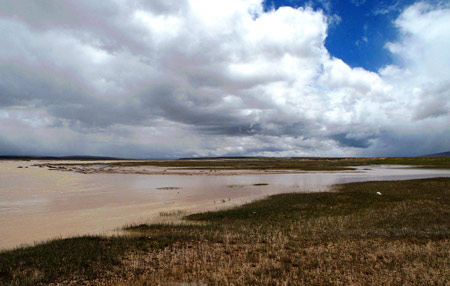
Global warming might endanger aquatic life in the source regions of the Yangtze River, a recent research report on fishery resources found. Although the ecological environment and fish resources remain in good condition at the source regions of the Yangtze, a group of leading Chinese scientists on aquatic animals found that global warming has forced some fish species upstream, which can have damaging implications. The Yangtze, the country's longest river, originates from glaciers at the foot of Mount Geladandong on Qinghai-Tibet Plateau in Qinghai province. Extending over some 159,000 sq km, the Yangtze sources comprise Tuotuo, Dangqu and Qumar rivers. The average altitude is between 4,400 m and 4,700 m. Near the Tuotuo River Bridge, the research team caught several Bilobed-lip schizothoracins, with the largest weighing more than 750 grams, which historically have not been found in that area. It is a stark contrast with other fish species, which usually measure only about 10 cm, living in the Yangtze sources "These small fish are endemic species on the Qinghai-Tibet Plateau," said Tang Wenjia, an engineer with the Qinghai Provincial Fishery Environmental Monitoring Center. "As an adaptation to the extreme weather conditions and high altitude here, they grow at a very slow pace, only about 1 cm per year," he said. The larger Bilobed-lip schizothoracin originally lived in Jinshan River on the upper reaches of the Yangtze, according to Chen Yifeng, a researcher with the Institute of Hydro Biology (IHB) under the Chinese Academy of Sciences (CAS).
The research team caught another batch of Bilobed-lip schizothoracins in Qumalai county in southwestern Qinghai province. Most weighed more than 500 g. "This means the species has already moved upstream in a relatively large quantity," Chen said. Hard-hit plateau The Qinghai-Tibet Plateau is among the regions hit hardest by global warming, which will have direct and long-term effects on the aquatic animals living in this area, said Wang Ding, a veteran expert from IHB. Statistics show that the temperature in the Tibet autonomous region rose by an average of 0.32 C every 10 years between 1961 and 2008. That rate of warming was much faster than the average across China, where temperatures rose by between 0.05 C and 0.08 C every 10 years during that period. The situation is similar in neighboring Qinghai province. The rising temperatures have led to the continuous melting of glaciers, scientists have found. After the Arctic and Antarctic, the Qinghai-Tibet Plateau has the third-largest number of glaciers. But 82 percent of glacier surfaces on the plateau have retreated, and the glacier area itself has decreased by 4.5 percent during the past 20 years, according to Qin Dahe from CAS. Qin is the former head of the China Meteorological Administration, and he is former co-chair of a working group for the Intergovernmental Panel on Climate Change. "Due to global warming, glaciers on the Qinghai-Tibet Plateau are retreating extensively at a speed faster than in any other part of the world," Qin said. "In the short term, this will cause lakes to expand and bring floods and mudflows," Qin said. Another threat from warming is the degradation of permafrost, or perennially frozen ground, Qin said. "Permafrost plays a vital role in protecting the ecological environment and hydrological cycles. But it has been breaking down during the past 50 years," Qin said. All these events could mean catastrophic changes for the aquatic animals in the Qinghai-Tibet plateau, as they are very fragile to any slight alteration of habitats, according to Chen of IHB. Upsetting the balance "Changes of topography and river directions are common in the Qinghai-Tibet plateau," Chen said. "But the wetland degradation as a result of warming may threaten the fate of aquatic life," he said. Introducing new species forced upstream also might lead to upsetting the ecological balance in the river sources. "The result is still hard to predict at the moment," Chen said. The survey was jointly conducted by the World Wildlife Fund, IHB, Yangtze River Fishery Resources Management Committee and the Qinghai Provincial Fishery Environment Monitoring Center. This is the first time that Chinese scientists have conducted a thorough survey of fish resources in the source regions of the Yangtze, said Wang Limin, deputy conservation director of the World Wildlife Fund. "This survey will help to give us a panoramic view of the fishery resources in the source regions of the Yangtze, and help us understand the impact of climate change on aquatic life in the river," Wang said. "The Yangtze River is facing different challenges posed by global warming at different river sections," she said. "Knowing what is happening in the source regions will help us better mitigate and adapt to the changes." (For more biz stories, please visit Industries)
|
||||||||
主站蜘蛛池模板: 安义县| 三江| 杭锦后旗| 清丰县| 南丰县| 岳阳市| 常熟市| 黔东| 温州市| 澜沧| 静安区| 浦县| 延吉市| 江门市| 应城市| 廊坊市| 奇台县| 翼城县| 乌拉特后旗| 兰考县| 长海县| 收藏| 宝丰县| 高要市| 高阳县| 大洼县| 梅河口市| 宜黄县| 亚东县| 三原县| 鹿泉市| 张家口市| 松桃| 台前县| 宝坻区| 神农架林区| 渑池县| 台北市| 如东县| 遂溪县| 蕉岭县| 鲁甸县| 嘉峪关市| 三亚市| 水城县| 汝州市| 博兴县| 团风县| 万源市| 东明县| 宿松县| 达孜县| 三明市| 呈贡县| 彩票| 开化县| 塔城市| 通州市| 定远县| 黑龙江省| 乐昌市| 叙永县| 龙山县| 汝州市| 舟山市| 乌审旗| 恭城| 惠州市| 土默特左旗| 黎城县| 合阳县| 聊城市| 手游| 山东省| 江口县| 阜平县| 昌黎县| 黑水县| 定南县| 曲麻莱县| 措美县| 临沂市|