Opinion
What to expect from market this year
By Ma Jun (China Daily)
Updated: 2010-01-13 07:58
 |
Large Medium Small |
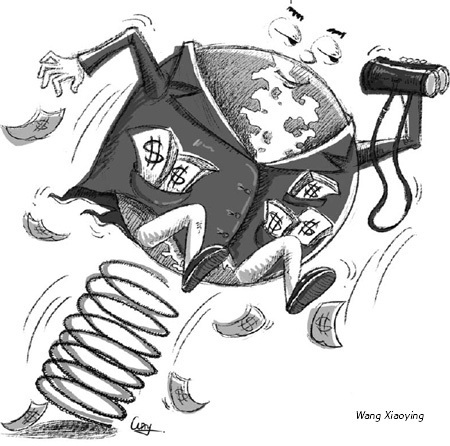
The economies of developed countries are expected to rebound further this year. They, however, could experience a second slowdown in the later half of the year.
Major developed countries, especially the US whose growth is most critical for the world economy, are likely to witness a remarkable recovery. In fact, America's GDP growth, down 2.4 percent in 2009, is expected to register a 3.6 percent rise this year. The economies of European Union (EU) and Japan are likely to grow, too, between 1 and 2 percent.
The factors causing fluctuations in the US economy include inventory, consumer durables and investments in real estate and fixed assets. Because of last year's sharp decline in the prices of raw materials and commodities - owing to the global economic crisis - many companies have to reduce their stocks-in-trade. Since consumer durables are non-essential items in the short term, their sales significantly dropped in America during the crisis period.
But now, despite unemployment remaining high, many people have begun buying non-necessities because of resurgent consumer confidence.
In the short run, the US economy could perform beyond expectation, because of increasing inventory, resurgent consumer confidence, fiscal stimulus and other factors.
But I believe the US economy could see another slowdown in the second half of this year. Since the fiscal stimulus cannot last forever, inventory can rebound only up to a certain extent, consumer confidence will rise up to a level before stabilizing, and the incentives boosting economic growth will weaken by mid-2010 causing US growth to drop to about 3 percent by the end of the year from a projected 4-5 percent in the first quarter.
What is foreseeable is that the dollar will gain strength. Previous experiences show that six months after the peaking of the unemployment rate, the US Federal Reserve begins raising the interest rate. It is estimated that the US unemployment rate peaked at the end of 2009. So it is highly likely that the Fed will raise the interest rate by 100 basis points by the third quarter of this year and by another 200 basis points in 2011.
Based on our Deutsche Bank estimation of the EU economy and inflation, European banks, too, could start raising their interest rates in the third quarter. Their pace, however, would be slower than the US'. This will cause the gap between the dollar and the euro to narrow, and thus strengthen the greenback.
Moreover, as the US economic recovery would be faster than that of the EU or Japan, America is expected to attract more equity-like capital, which would push up the value of the dollar further.
China began tightening its monetary policy in the third quarter of 2009, a period when the growth in new loans in one month fell by about 70 percent compared with the first half of the year. But it is expected that China will take its manufacturing capacity utilization level to the high points of 2007 and 2008 by the end of this year.
This obviously will increase investment in the manufacturing sector, making it the driver of a U-style rebound.
| ||||


Export shares have performed remarkably better than major shares. And as the pace of US economic growth accelerates, exports and related industries such as container transport and ports would perform well in the short term.
Fixed asset investment in China is mainly driven by government-led investment and capital injection into the manufacturing and real estate sectors. The growth of fixed asset investment is estimated to drop from 32 percent in 2009 to about 19 percent this year. And the growth rate of fixed asset investment, backed by budgetary funds, is expected to drop from 75 to 20 percent - something that has been documented by the Central Economic Work Conference, too.
The government had wanted to "significantly improve public investment". But now it has turned to "strictly limiting new projects". This shows the growth rate of investment in infrastructure will slow down markedly. Plus, with the increasing introduction of policies aimed at containing speculative demand in the property market, real estate investment may slow down after the second quarter this year.
Retail sales will see a stable growth, though some sub-sectors like insurance, food packaging, online travel, medical equipment, spices, milk, fruit juice, red wine, cosmetics and chocolates could grow faster. In these sectors, China's per capita consumption or product penetration is less than 20 percent of the world average, which indicates a great potential for continued growth. But in some areas China's per capita consumption is much higher than the world average, such as instant noodles (250 percent of the world average), pork (240 percent) and bicycles (200 percent).
Uncertainty is a double-edged sword for the capital market. Inflation, asset bubble and policy responses would be major sources of uncertainty in financial markets this year. I estimate that the consumer price index (CPI) will rise by at least 1.5 percent. But if several negative factors, such as rise in food, housing and oil prices and the after-effects of the expansionary monetary policy come together, the CPI could even rise by 5 percent.
The author is the chief economist for Greater China at Deutsche Bank.