Bizchina
Growing costs
By Hu Yinan, Li Jing and Wang Shanshan (China Daily)
Updated: 2010-01-22 07:44
 |
Large Medium Small |
Dianchi Lake epitomizes the cost China's rapid development and economic growth: Environmental and ecological deterioration.
The country's economy has expanded on average 9.7 percent every year for three decades. The rate of growth has forced China to deal with the kind of environmental woes industrialized countries once faced, only over a shorter period of time. Developed countries began addressing ecological concerns when their per capita GDP reached $20,000, but China must now achieve the same results when its per capital GDP is only about $3,000, environment officials said.
Faced with mounting challenges in recent years, the central government is determined that green growth is the only way to ensure future prosperity. As Zhou Shengxian, the environment minister, put it: "It is a disgraceful lifestyle to drive a BMW but have only dirty water to drink."
The success in imbuing the green growth concept in the minds of local government officials will determine whether China can solve its development dilemma.
To prevent the nation's economy from suffering further from the global financial crisis, local authorities are once again blindly pushing through polluting projects rather than fueling "green GDP". 
A pilot project to calculate green GDP - a system designed to gauge real economic growth by deducting the cost of environmental pollution - was conducted in 2005 by the Ministry of Environmental Protection (then-State Environmental Protection Administration) and National Statistics Bureau.
The findings were released the following year and showed environmental damage had cost the nation almost 512 billion yuan in 2004, about 3 percent of that year's GDP.
No subsequent reports have been released and analysts say this is because local governments are opposed to the publication of disappointing results.
Nobel Prize-winning economist Joseph Stiglitz recently called on people to "get away from GDP fetishism and to understand the limits of it". GDP alone is insufficient in truly measuring a country's economic health and sustainability, while human wellbeing must be considered, he said.
Unemployment also poses another threat to the sustainability of China's economic growth.
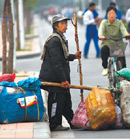
Manufacturing industries in coastal regions have started to pick up the pieces and the country is well on its way to becoming the world's largest exporter. But overseas demand for Chinese products is far from the pre-financial crisis levels and many people, especially among the nation's 225 million migrant workers, have struggled to find work.
At the beginning of last year, it was reported that 20 million migrant workers were left out of work due to the economic slowdown.
There is no official figure available to the exact number of people unemployed in China but the State Council has vowed to keep the registered unemployment rate below 4.6 percent this year - the highest since 1980.
A report published by the Chinese Academy of Social Sciences in late 2008 predicted registered unemployment could hit 10 percent last year. But through series of policy incentives and investment, the country limited the rate to 4.3 percent as of September, slightly higher than in 2008, said Yin Weimin, minister of Human Resources and Social Security.
China's export industry can no longer create the same number of jobs it did before the economic crisis, say analysts, and the country has been forced to find ways to boost domestic consumption.
Many of the migrant workers who were laid off last spring have already returned to the job market and eased concerns about a potential labor shortage, said Li Peilin, director of the academy's institute of sociology.
However, Niu Dao, a real estate expert with cnstock.com, insisted the situation could be more daunting than what labor officials say.
"Between January and October last year, power consumption by the light manufacturing industry experienced a year-on-year fall of 1.9 percent, according to figures from the National Energy Administration," said Niu. "That translated into a lack of contracts on the part of these enterprises and fairly accurately reflected the real employment conditions."
Most new loans made by Chinese banks last year went to the coal, power and transport sector, with the real economy not receiving much in comparison, Niu argued, citing figures released by the National Development and Reform Commission.
"At least 80 million migrant workers are employed in the light manufacturing industry. A drop in the industry's power consumption means people lose their jobs. I estimate around 31 million people were in fact jobless as of last October," he said.
|
||||


A scandal involving a university that faked a job contract for a student to push up its employment rate also knocked confidence in the country's job market. High employment rates for new graduates help promote colleges, but it has discovered some were manipulating their figures by making out contracts for jobs that did not exist. At the time, the government had placed jobless college graduates atop its agenda.