Top Biz News
China's shining light in the energy challenge
By Andrew Moody and Bao Chang (China Daily)
Updated: 2010-02-22 11:11
 |
Large Medium Small |
Entrepreneur believes 60 percent of the world's power will come from the sun 100 years from now
XINYU: Peng Xiaofeng is not one to be deterred from his personal mission by the heavy rain pouring down outside his office.
It might be a dreary day in Xinyu but the 34-year-old insists solar energy will provide 60 percent of the world's energy supply in 100 years.
 |
|
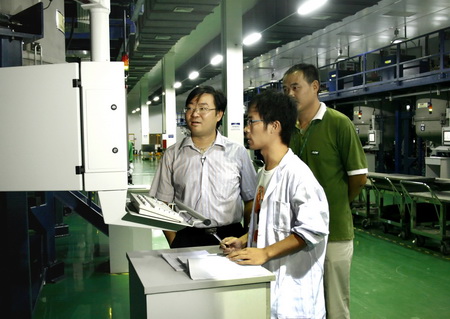
Peng Xiaofeng (left) inspects the production line at the LDK silicon factory located in Xinyu city, Jiangxi province. [File photo] |
The modest and quietly spoken chairman and chief executive officer of LDK Solar, one of China's leading solar energy companies, insists sun power will eclipse coal, gas and oil in the 22nd century.
One of China's leading young entrepreneurs and listed by Forbes magazine as one of the 500 richest men in the world, he believes people consistently underrate this natural form of new energy.
China's solar power usage currently barely registers above zero as a percentage of total energy sources.
"In 100 years, my view is that 60 percent of the world's energy will come from solar power," he said.
"This is not an optimistic prediction. The European PhotoVoltaic Industry Association (one of the solar energy industry's main trade bodies) puts the figure at 80 percent."
Because of their current marginal status, it is all too easy to dismiss new energy sources as something of a sideshow to ease climate change fears.
Renewable energy target
The Chinese government, however, wants 20 percent of the country's power to be from renewable energy (of which hydro will be a major part) by 2020.
Peng insists people fail to realize existing energy sources, oil in particular, are going to run out.
"Oil, maybe, has 50 years, I don't know. That is because it is not very renewable. It is also going to get more expensive. Even with the background of a financial crisis like now, its price has gone back up to $81 a barrel," he said.
LDK has had something of a torrid time itself recently. Its shares on the New York Stock Exchange initially soared to nearly $70 from their initial flotation price of $27 in 2007 but have since slumped to just a tenth of their peak value at around $7.
With Peng owning around 70 percent of the equity of the company, this has put a considerable dent in his personal fortune, although he still retains major private interests.
In December, the company went back to the NYSE and has raised a further $122 million, using around $90 million of the proceeds to pay back short-term debt as well as develop other aspects of the business.
"The economic crisis has affected everybody and, in particular, solar energy. Many projects have been delayed, mainly because of the problems in getting bank finance," he said.


"The company's market share is increasing, our cost leadership is getting stronger and we are placing a great deal of emphasis on technological innovation this year," he said.
You have only got to drive around Xinyu to see how much depends on Peng's efforts.
The city in Jiangxi province is now known as 'Solar Power City'.
Around 80 percent of LDK's 14,000 employees are from the city itself. The presence of LDK has also generated a cluster of other companies from processing raw materials to all other aspects of solar power engineering.
LDK has also established schools to train people to work in the solar power industry and it has also contributed towards the city's infrastructure, including helping fund the main Saiwei Road.