Top Biz News
Iron ore traders eye big prize
(China Daily)
Updated: 2010-02-25 09:49
 |
Large Medium Small |
 |
|
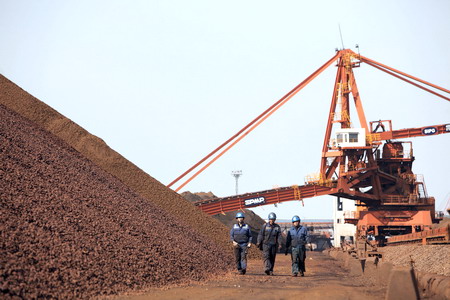
Workers at an iron ore transfer and storage center in Shanghai. The iron ore market is worth about $200 billion a year, second only to crude oil, according to Credit Suisse Group AG. [Agencies] |
ISTANBUL/LONDON: Sitting at his desk on ICAP Plc's dealing floor in London, iron ore broker Andy Strickland is plotting how to get business in China.
He handles so-called swaps for iron ore, allowing buyers and sellers to fix prices months in advance for single cargoes of the raw material that's essential in steelmaking.
Strickland said he aims to expand his two-man team to eight, the same size as the nearby coal desk whose brokers are busy shouting into their telephones, and handle more deals as steelmakers increasingly favor buying individual iron ore consignments instead of relying on fixed-price supply agreements.
"The potential is huge," Strickland said. "You just need a catalyst for it to reach that critical mass."
The prize for the growing band of brokers and traders handling the derivatives is the possibility that iron ore will evolve into a market rivaling the liquidity and volume of other commodities.
The iron ore market is worth about $200 billion a year, second only to crude oil, according to Credit Suisse Group AG. The swap market may grow 10-fold to 360 million metric tons annually over the next two years, said Phillip Killicoat, an iron-ore dealer at the bank in London.
Such an expansion would be a vindication for the pioneers in a market that only began in May 2008. Ray Key, global head of metal trading at Deutsche Bank AG and Kamal Naqvi, Credit Suisse's global head of investor sales, began offering swaps at the instigation of BHP Billiton Ltd, the world's largest mining company, which was dissatisfied with the way iron ore is priced.
Incredible size
"Iron ore struck us as one of the last of the true commodity markets that did not have any financial presence," said Key, who likens iron ore trading to where oil trading was in the 1980s. "Its size is just incredible."


The benchmark traditionally takes effect from April 1. Asian steelmakers pushed for price cuts in 2009, the first in seven years, after the biggest slump in demand for their product since World War II.
The three largest iron ore producers - Brazil's Vale SA, London-based Rio Tinto Group and BHP - and Japanese and South Korean steelmakers agreed to a 33 percent reduction.
Growing volatility
That wasn't enough for Chinese customers. Price talks with the world's biggest steelmaking nation ended in deadlock and a benchmark wasn't officially recognized, helping to opening the market to spot cargoes.
"I don't think anyone could foretell just how dire the negotiations would become," said Key, who joined Deutsche in 2007 after five years as global head of precious metal at Morgan Stanley.
Growing price volatility also helped stoke demand for spot iron ore cargoes and swaps.
"The benchmark system is untenable in the long term," said Strickland at ICAP, the world's largest broker of transaction between banks. "Market sentiment changes on a monthly basis."
Some steelmakers aren't welcoming the trend. Customers of Japanese steelmakers wouldn't want more frequent change in raw material costs, Shoji Muneoka, Nippon Steel Corp's president and the Japan Iron and Steel Federation's chairman, said at a JISF conference last month.