Economy
China to gain in US export curbs revamp
By Ma Liyao and Cheng Guangjin (China Daily)
Updated: 2010-04-22 07:47
 |
Large Medium Small |
BEIJING - The United States seeks to revamp its Cold War-era export control system, which, if effectively implemented, may allow more hi-tech products into China, said analysts.
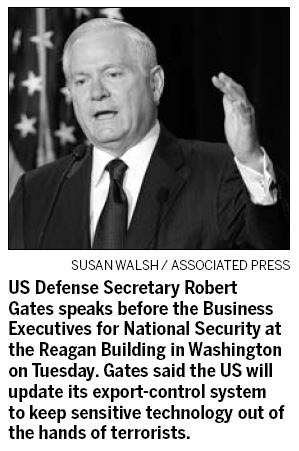
"America's decades-old, bureaucratically labyrinthine system does not serve our 21st-century security needs or our economic interests," US Defense Secretary Robert Gates said in an address before members of Business Executives for National Security, a non-partisan organization of business leaders, in Washington on Tuesday.
The proposal is focused on dual-use technologies, and items like computers and helicopter spare parts that are sold commercially for civilian use but which can also be used for military purposes.
Gates sketched out a three-phase program to create a single authority to regulate export licenses for sensitive technologies, streamline applications and boost exports.
Gates said he wants Congress to pass a reform bill by the end of the year, but many lawmakers in the Congress are worried about proliferation and changes that might weaken controls and allow dangerous parties to exploit US technology.
The US currently has two export-control lists, with one maintained at the State Department and the other by Commerce.
Gates said his proposals of a single list would enhance protections on the most sensitive technologies. He also cautioned that the current system risked pushing companies and sales contracts abroad, without adequately safeguarding national security.
"Multinational companies can move production offshore, eroding our defense industrial base, undermining our control regimes in the process, not to mention losing American jobs," Gates said.
The Financial Times reported that industry groups have long advocated an overhaul of export controls, frustrated by an obsessive and Byzantine system that splits responsibilities for different products and technologies between the departments of commerce, state, energy and defense.
Pang Zhongying, a senior expert on world politics at the Beijing-based Renmin University of China, sees the likely improvement in US export restrictions as a signal that more hi-tech products would enter China.
"China needs the most advanced technologies and high-end products, which the US has restricted, basically due to our different ideological systems," Pang said. "Some of the restrictions are out of date and are no longer necessary."
China has been urging the US to revamp the export restrictions for hi-tech products, which the US has refrained from doing since the 1990's, said Tao Wenzhao, an expert on US studies at the Chinese Academy of Social Sciences.
"The portion of hi-tech products that US exports to China does not match with its status as the second biggest trade partner of China," said Tao.
Commerce Minister Chen Deming said in March that China's imports of hi-tech products have been growing rapidly in recent years, but those imported from the US declined to 7.5 percent of the entire imported products in 2009, from 18.3 percent in 2001.
In 2008, China imported a total of $340 billion worth hi-tech products, of which those from the US took up 7 percent, lower than the 9 percent from the European Union and 14 percent from Japan. In the eight years from 2001 to 2008, China's imports of hi-tech products from EU increased by 168 percent and 283 percent from Japan, while the figure for that from US was only 106 percent.
Commerce Minister Chen said in an interview to The Washington Post in March that the best way for the US to increase its exports to China would be to relax restrictions on the export of hi-tech and dual-use goods to China. Chen said those limits have amounted to billions of dollars a year in trade.
According to Chen, China sought to buy engines for Black Hawk helicopters that the US sold to China in the 1980s, for rescue works after the Sichuan earthquake in 2008, and the endeavor was rejected by the US due to doubts over its military use. China solved the problem by borrowing helicopter engines, and subsequently buying helicopters, from Russia, Chen said.
The same holds true for satellites, Chen added. China would rather buy them from the US, but concerns over export controls have forced it to source satellites from Europe, Chen said. "This is the reason that our trade balance with the US is skewed," he said. "The US has strict export controls to China."
"Even if the US restricts hi-tech products to China, China could buy from other countries, like the EU and Japan" Tao said. "Commercial competition also forced US industries to urge the government to revamp export restrictions."
Tokyo is looking to ease its self-imposed arms exports ban. Financial Times quoted Akihisa Nagashima, a parliamentary vice-minister of defense, as saying the move reflected concern about the competitiveness of the country's defense industry and the high prices its military must pay for arms that are often less than cutting edge.
EU and China have already set up a hi-tech trade working group, which will promote exchanges and investments in hi-tech products between the two sides, the EU Ambassador to China Serge Abou said last year.
Agencies contributed to the story.
CHINA DAILY
(China Daily 04/22/2010 page11)