Bizchina
Goodbye Barbie, hello Fisimi
By Yu Tianyu (China Daily)
Updated: 2010-07-26 09:38
 |
Large Medium Small |
|
 |
|
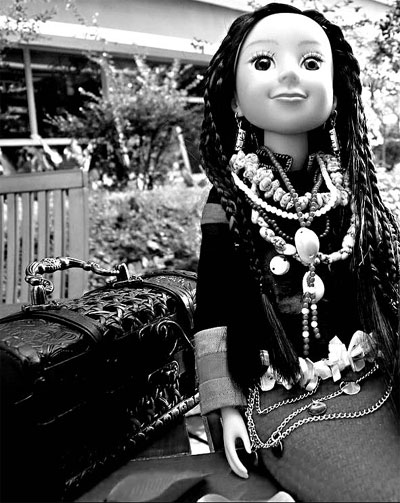
A Fisimi doll which features a Luoba ethnic woman with her trademark long braids. The Luoba are an ethnic group living in Southeast Tibet. [Provided to China Daily] |
At the outset, Ju and her partners (she always emphasises it is a partnership to stress the role of teamwork in the operation) enlisted the help of students and academics from South China University of Technology in Guangzhou to help them collect information on the 56 ethnic groups and build up a database.
They conducted thorough investigations nationwide, talking to folklore experts to ensure every detail of the dolls was true to the facts and traditions as well as to avoid any of the taboos found in local religions and culture.
The task was not made because the development of the Internet and 3G technology has accelerated the disintegration of many traditional cultures.
"I visited a silversmith in Guizhou province and asked him to teach me his skills because I was amazed at his exquisite craftsmanship," Ju said.
"But his reaction was one of helplessness. He said he would rather go with me to work in cities. He told me I would have nothing to eat if I did his job."
After conducting research in Guizhou, Yunnan, Tibet and other provinces with a strong ethnic presence it became obvious that possessing traditional craft skills did not guarantee a decent income.
|
|||


"It's not enough to help them sell their hand-made cloth products or other things with little added-value. That won't enable them to cast off the shackles of poverty and set out on a road to prosperity," Ju said. "From our perspective and business experience, creating a brand of products enjoying widespread popularity is the right way to help them."
At the same time, Ju and her partners are convinced the country also badly needs such a brand to revise the old image of Chinese products as being cheap and of such low quality that they can only be sold at simple stands in markets.
"Our dream is to make our Fisimi dolls become stars in the world's leading auction centers and art galleries," said Ju.
"Just as the Barbie doll is representative of American culture and values across the globe, so should Fisimi dolls act as ambassadors for Chinese culture. After all, so many people from all over the world have traveled to China in recent years and become more and more curious about Chinese culture.
"When the task is so important it is incumbent upon us to pursue accuracy more strictly."
When the team was designing the Fisimi doll representing the Mongolian ethnic group, they encountered problems because very few local workers were able to make the silver accessories, which are an essential part of the costume.
Experts from the Inner Mongolia autonomous region helped them eventually to track down an old craftsman. After telling him of their dreams and challenges, the artisan was touched and agreed to make mini-molds of the accessories for Fisimi dolls.
The Mongolian Fisimi doll measures about 40 centimeters in height and is dressed aristocratically, with the luxurious Ordos head ornament and riding boots.
Negotiation with artisans is tough since most of them insist on using old techniques and refuse to employ any innovations.
"But, if you are making a mini-mold of traditional items, you would find some details cannot be created for a tiny surface," Ju said. "You have to change."
Furthermore, in some regions, people are reluctant to reveal the secrets of their ancestral crafts to people who aren't family.
"You have to tell them why you need their crafts and how valuable they are and what you will do to conserve them time and time again," Ju said.