Economy
ADB defends 'middle-class' bracket report
By Wang Zhuoqiong (China Daily)
Updated: 2010-09-17 07:46
 |
Large Medium Small |
 |
|
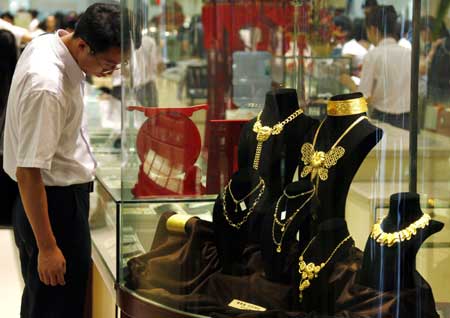
A customer looks at jewelry at a department store in central Beijing Aug 13. David Gray / Reuters |
Beijing - The Asian Development Bank (ADB) has defended its recent report, which had classified just over 800 million people in China as middle class saying its definition had used differing yardsticks to distinguish Asia's middle class from those in Western nations.
The ADB's August 19 report - "The Rise of Asia's Middle Class" - had included people consuming between $2 and $20 a day in the middle-class category, going by which definition some 817 million people in China would come under that bracket.
At the time, the report was received with much skepticism, and was panned widely by Chinese media outlets and economists.
ADB economists however defended the report in an interview with China Daily.
"We really measure middle class against the Asian background," said Wan Guanghua, principal economist of ADB. "Among developing Asian economies, China is quite well-off."
"Furthermore, a fairly large proportion of China's middle class falls into the $2 to $4 a day income group, who are vulnerable to poverty on the one hand, but lead a better life than many in poorer Asia-Pacific nations such as Papua New Guinea and Cambodia."
According to the ADB report, Asia's middle class had risen to 56 percent of the population - or nearly 1.9 billion people - in 2008, up from 21 percent in 1990.
The middle class of China is currently larger than all others in absolute size, having added 800 million people to its ranks between 1990 and 2008, the report stated.
"Though $2 sounds low, it is above the international line of $1.25 for defining moderate poverty," said Douglas Brooks, assistant chief economist at the ADB. "People who live on $4 to $10 or $10 to $20 are closer to the broader international definition of middle class. The upper range is more relevant to China as that lies between developing Asia and the Organization for Economic Cooperation and Development (OECD) nations."
| |||||||



On this issue, perceptions may vary across nations. "It is a subjective question," said Niny Khor, another ADB economist.
"When you look at China, its income distribution is moving up rapidly. With our projection, what is most striking is that developing Asia's total consumption will be larger than the OECD's by 2030. A large part of the middle class is from China. These have strong implications to the world trade pattern."
Tang Min, deputy secretary of the China Development Research Foundation, told Xinhua News Agency last week that despite the rapid growth in the number of people in the middle-income bracket, it is hard to ignore the fact that China is a developing country with a large number of people in the low-income group.
According to the World Bank, China's gross national income per capita was ranked 120th in 2009.