Opinion
Rare earth elements undervalued
By Guo Chaoxian (China Daily)
Updated: 2010-10-12 11:00
 |
Large Medium Small |
Rare earth elements are referred to by many names such as "vitamins for industry" and "elements of the future". Their importance lies in their being widely used in industries, especially electronic devices.
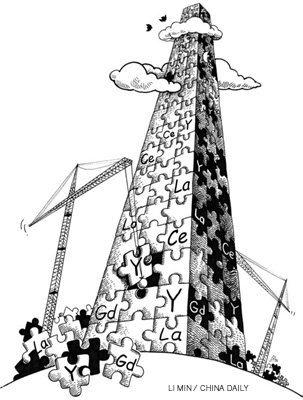
China produces, uses, reserves and exports the highest amount of rare earth. The rare earth market in the country was disorderly before 2005 because of the lack of proper supervision and regulation. In fact, chaos was the name of the game until five years ago as many small-sized enterprises, with poor efficiency and no long-term plans, exploited rare earth. The rare earth metals were not only wasted because of poor storage facilities, but also some strategically important ones were smuggled out of the country, dealing a blow to the national economy and security.
But local government departments have now taken measures, such as adjusting the export quotas and increasing tariff ratios, to restore order and regain control of the pricing rights. Thanks to their efforts the situation has improved to a large extent.
Now that the central government has decided not to issue more permits for extraction and trade in rare earth in the near future and Chinese enterprises have a larger say in setting its price, one can hope over-exploitation of the elements would be controlled. But some deep structural problems still exist, which threaten to limit the long-term development of the industry.
The most urgent of these problems is the pricing rights. China is the largest producer and exporter of rare earth, but it does not enjoy enough rights to set its price in the international market. This can be partly attributed to its "atom-like" internal market structure. The number of Chinese enterprises extracting and exporting rare earth is too large. But being small, none of these enterprises is strong enough to influence the price.
According to the laws of economics, an oligopoly favors giant enterprises (which are few in any industry). But China is no oligarch, even though it is the largest producer of rare earth.
So to strengthen its pricing rights, China should first restructure the domestic rare earth market. Several enterprises have formed loose alliances or cartels to have a larger say in the price mechanism and to better protect the precious resource. These efforts are welcome but far from enough. Such alliances (or cartels) have several problems. For example, since such alliances lack stability, their members can break contracts at random.
Therefore, the governments' policy should be to support mergers of and restructuring among enterprises. In other words, it should help bigger enterprises to purchase the shares of smaller ones to create a more integrated market. In an ideal situation, three to five giant enterprises should be left to exploit rare earth.
The governments should set higher benchmarks for technological development, environmental protection and production safety, so that inefficient enterprises withdraw from business and the market is restructured faster.
The rare earth industry not only needs the support of the governments, but also has to pay attention to social organizations such as business guilds to gain in strength. Alliances like the China Non-ferrous Metals Industry Association could render service to trans-border interaction. Their non-official identity grants them a unique advantage in coping with international matters. And they act as catalysts for official contracts.
Another key measure would be to introduce a product storage regime to better balance market needs and supplies. Rare earth can be preserved in two ways: by closing the mines and by storing the extracted elements properly. Since the mines have already been exploited to a great extent, storing the rare earth elements properly would be the better of the two options now.


Rare earth elements such as lanthanum, cerium, yttrium, gadolinium and their compounds may fetch low prices now, but they could have great application potential in the future. Hence, the central government should buy them to better defend strategic interests.
And lastly, the central government should establish a forward market for rare earth elements. Currently, global prices of metals and minerals are determined by the negotiating parties or forward markets. The price of iron ore, for example, is agreed through negotiations, while those of many non-ferrous metals are determined by forward markets. Prices of copper, lead and some other metals follow those set by the London Metal Exchange, which has become the global standard.
Rare earth elements are non-ferrous in nature and often attract huge investments. Therefore, establishing a forward market for rare earth can help China regain the pricing rights. China's abundant rare earth reserves - and the possible emergence of a couple of giant enterprises in the country - could give it a bigger say in the international market. To regain the pricing rights, China could also set up a rare earth exchange or put rare earth on the Shanghai Futures Exchange.
The author is a research scholar at the Institute of Industrial Economics of the Chinese Academy of Social Sciences.