Opinion
Increase imports, enjoy benefits
By Zhu Jin (China Daily)
Updated: 2010-10-14 11:16
 |
Large Medium Small |
China has been under tremendous pressure, especially from the United States, to revaluate its currency more rapidly. Many a suggestion has been put forward to ease this pressure without harming the national economy. One of them is to encourage more imports, especially from Western countries, to balance international trade.
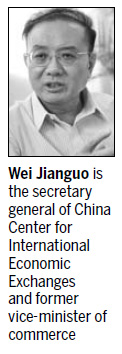
Wei Jianguo is one of the people who first supported the new import strategy. The secretary general of the China Center for International Economic Exchanges and former vice-minister of commerce, says the import strategy would play a very important role during the 12th Five-Year Plan (2011-2015). "It is just the right time to lay emphasis on imports" not only to end the debates on the yuan's revaluation, but also to help China's economic development in the long term. An effective import strategy can help the industrial transformation of the country and optimize the economic growth mode.
China's exports rose 25.1 percent in September from a year earlier to $144.99 billion, but the pace of growth slowed from August's 34.4-percent surge, the General Administration of Customs said on Wednesday.
The country's imports rose 24.1 percent year on year to reach $128.11 billion last month, with the growth rate down 11.1 percentage points from that in August. Thus, increasing imports could be the best way of balancing international trade.
Wei gives three examples to prove his point. The first is the Association of Southeast Asian Nations (ASEAN). At a forum in November last year, economists said one of the vital reasons why ASEAN member states didn't suffer much from the global financial crisis was that they continued to export goods to China. ASEAN member states and China have been trading more than 7,000 zero-tariff commodities since January this year. It is important for China to stick to this policy to share high economic growth rates with other countries.
The second example is that of Japan. Trade between China and Japan has increased by about 30 percent this year, higher than that with the US and the European Union during the same period. The high growth rate of Sino-Japanese trade can be attributed to the change in Japan's strategy to invest in China's market instead of investing in transit.
Wei cites a meeting at the beginning of the year with Carlos Gutierrez, former US secretary of commerce, as the third example. The US wants to reduce its trade deficit with China, and China wants the US to lift the restrictions on the export of advanced technologies. So, the two sides at the meeting agreed that changing China's import strategy could end the trade dilemma.
"These examples show a new import strategy is a suitable choice for China's economy and to maintain international trade balance", Wei says. "It is necessary to establish a long-term trade relation with ASEAN member states and other developing countries by giving priority to imports. Imports, however, would include the transfer of advanced technologies from developed countries."
Wei says the government should include a new import strategy in the 12th Five-Year Plan. "In the country's interests, we should encourage import of more consumer goods to meet domestic demand. But it is important to regulate imports with a low-carbon economy principle - buying more advanced materials and technologies and fewer high-polluting and high energy-consuming products."
The Shanghai Import Commodity Exhibit Trade Center, the first national-level import center, was founded in August. On Aug 17, Yao Jian, spokesman for the Ministry of Commerce, said China was adopting a series of policies to increase its imports and balance the trade deficit from this year. That was an indication of the country adopting a new import strategy.
The international response to China's new trade policy is mixed. In an article in The New York Times on Sept 12, Paul Krugman, winner of the Nobel Prize for economics, asked the US to learn from Japan, and pay attention to China's trade policies, especially its currency policy.
Wei's response to Krugman is: "A new import policy can ease the pressure on China to revaluate the yuan faster. But Krugman should feel relieved because the fundamental goal of China's import policy is to ensure Chinese people benefit from trade and advanced technologies Moreover, China likes to share new ideas and technologies with the world, too."


Wei says China can exchange its potential market with advanced technologies by following the process of import, absorb and create. At the microcosmic level, China should use imports to encourage enterprises to establish themselves in overseas markets. And to boost consumption, the government should consider granting subsidy on imports and adjusting the import tax in some areas.
The question is that China is accused of keeping its currency weak, The currency issue has become more of a political issue. But since the essence of international trade is a win-win game, the best long-term result is not trade surplus but optimization of the import and export structure.
Many economists across the world are debating whether a drop in China's trade surplus - because of rapid revaluation of the yuan - could help boost other countries' exports and create more jobs abroad. The answer, however, is uncertain, depending on the interests of different countries.A strategy to increase imports could be the right solution in such a situation, for it can boost domestic consumption and lessen the national economy's dependence on exports. It can balance international trade, too, and promote more stable and friendly relations between China and developed and developing countries both. Even if the strategy of increasing imports is not totally successful, it will still be a good way to balance international trade in a mutually beneficial way.