Economy
Crucial time ahead for SOE shake-up
By Chen Jialu (China Daily)
Updated: 2010-11-09 14:19
 |
Large Medium Small |
Cutting number of firms key task for SASAC
In the middle of this year, the State Council announced a target of reducing the number of State-Owned Enterprises to between 80 and 100 by the end of this year and about 20 more need to be merged in the final two months.
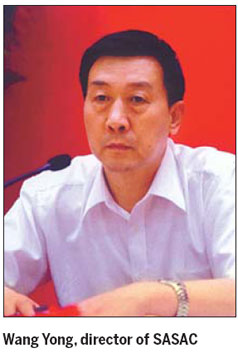
Two months ago, when the new director of the State Council's State-owned Assets Supervision and Administration Commission (SASAC), Wang Yong, took the helm, he faced a tough task: reduce the number of State enterprises from 122 to under 100 in a four-month period.
The fourth quarter is thought to be crucial to the restructuring process, but it is still not very clear which companies will be targeted.
Li Kaifa, a researcher at the SASACA-affiliated China Enterprise Reform and Development Society, said that after the establishment of the long-awaited Guoxin State Asset Management Company, some targeted companies that meet one of three standards will be put into it.
The former director of SASAC, Li Rongrong, said earlier that the ultimate goal of restructuring is not just to reduce the numbers, but to sharpen their competitiveness,.
One important part of the reform is to improve the "board of directors" system, Li said.
By September, 32 of the enterprises had set up boards of directors.
Difficult reforms
In fact, this reform process has been a long and tough one for SASAC.
A decade ago, the State-owned sector looked like an economic disaster waiting to happen. In the aftermath of the 1997 Asian financial crisis, average profit margins in State companies fell to close to zero, and many were reporting huge losses.
But, by 2008, the Aluminum Corporation of China's (Chinalco) acquisition of a 9 percent stake in Rio Tinto marked an important change - a quiet revolution under way in the State sector with a new generation of confident companies who had global ambitions.
China is trying to develop a series of leading public companies in industries that are exposed to cut-throat competition, where technology, design and marketing are crucial features. And that is just the sort of place where State companies have typically suffered at the hands of private rivals.
"In other words, what we are witnessing is an experiment in capitalism that could challenge much of the conventional wisdom about state ownership," according to columnists Geoff Dyer and Richard McGregor, whose comment appeared in a British financial newspaper in 2008.
At a time of increasing discussion about whether there is a genuine "China model" for economic development, involving a much larger role for the state, the fate of China's State-owned companies could help change the terms of the debate, Dyer and McGregor said.
State-owned enterprises are leaving their mark in a range of industries where there is plenty of competition and companies need both capital and a technological edge.
China is awash with private investment in steel, but the industry leader and most technologically advanced steel maker is still State-owned: Baosteel.
Meanwhile, Chinalco has rapidly become one of the world's leading producers of aluminum and alumina and is working on plans to become a diversified metals multinational.
At the same time, Shanghai Electric is increasingly taking on Japan's Mitsubishi and Marubeni in a bid to build new coal-fired power plants around Asia.
Not to be outdone, China's two State-owned shipbuilding giants - the China Shipbuilding Industry Corp and China State Shipbuilding Corp - are expanding rapidly and beginning to catch up with their Korean and Japanese competitors in technology.


"SOEs are increasingly competitive in attracting top executive talent," says David Michael, head of Boston Consulting Group's China office. "There are a number of local Chinese managers of multinationals or private sector companies who have gone to work in the State sector."
A similar remark comes from Yin Mingde, a partner at Allpku management consulting company, who said, "There have been increasing signs that China's SOEs are learning the skills of corporate finance. Chinalco's snap purchase of Rio Tinto stock was one example."
Several SOEs have taken on foreign strategic investors in recent years and some have multinational executives on their boards, Yin said, adding. "These relationships have not been without tensions, but they have helped to sharpen performance."
These reforms only explain part of the success of SOEs. According to Andrew Grant, head of McKinsey's China office, many of the successful Chinese companies have what he calls a "hybrid" structure, mixing features of private and State companies. The best SOEs gain financial firepower from their State parents but have sufficient independence to be managed like private companies, Grant said.
It is not actually that easy
Nonetheless, the SOE reform record has not been uniformly successful.
Older SOEs still can find themselves grappling with outmoded equipment and might have to purchase components and other supplies from affiliated companies, regardless of the quality or cost, said Zhu Boshan, general manager of the Shanghai TERC management consulting co.
To make matters worse, although corporate governance has improved, investors regularly complain about the lack of transparency in SOE finances, particularly over the transfer of assets between listed companies and their State-owned parent groups, Zhu said.