Economy
Pricy grain is forecast
By Lan Lan (China Daily)
Updated: 2010-11-22 11:04
 |
Large Medium Small |
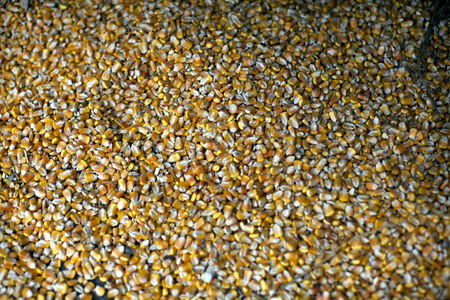
Spilled corn on the floor at Beiliang Port in Dalian, in Northeast China's Liaoning province.?[Photo / Bloomberg]
Costs increase as demand rises from competing industry sectors
BEIJING - China's imports of corn and soybeans are soaring with the former increasing by 8,644 percent to 1.22 million tons in the first nine months of the year.
Previously the country was almost a net exporter of corn but analysts predict this year imports will reach 1.65 million tons. Industry researchers said the country will boost its grain imports along with the nation's efforts in pushing forward urbanization.
Under increasing pressure from the limited amount of arable farmland available and the process of urbanization, moderate imports of grains are reasonable, said Cheng Guoqiang, a researcher for the Development Research Center of the State Council.
"This year's supply shortage and surging imports should be a special case. If the government continues to take efficient measures on ethanol and citric acid production, imports (of corn) won't be a regular situation," said Cheng.
China's annual output for corn climbed to 166 million tons in 2008. Last year the output declined because of cold weather. However output this year may rebound to 2008's level, researchers said.
China is the world's second largest user of corn. Driven by rising living standards and consumption of meat, poultry and dairy products, the consumption of feed for livestock has increased, and now accounts for about 80 percent of China's corn output.
In addition, the deep processing sector for starch, citric acid and ethanol production consumes about 35 million tons of corn annually. A total of 4 million tons is used in making ethanol alone.
"There is no problem in meeting demand for feedstuffs from domestically grown corn. If there's a supply shortage for corn, it would be caused by the surging demand from the processing sector, Cheng said.
Many businesses have moved into deep processing because it has yielded high profits over the past 10 years. The average annual growth rate of the industry rose 20 percent since 2000, while that of feedstuffs increased by 1.26 percent during the same period, said Cheng.
The active participation by processing companies in buying grain also fuelled corn prices, as they competed with each other for stock, he said.
The closer linkage between corn and energy has become an important element in the price fluctuations of corn, said Zhang Hongyu, deputy director of the policy department of the Ministry of Agriculture.
Corn has been widely used in making industrial ethanol and biofuel in the United States. Demand for corn will continue to increase given the shortage of oil supplies.
| ||||


"In the long term, imports of corn are very likely to increase, but large-scale imports similar to soybeans won't occur because the output is largely equal to the demand, said Xu Xiaoping, a researcher at the State Council's development research center.
China has imported about 50 million tons of soybeans this year, a figure that will continue to increase, said researchers.
Since 1996, China shifted from being a net soybean exporter to becoming a nation largely dependent on imported soybeans.
The crushing industry tends to use imported transgenic soybeans because they are cheaper. As a result, China's traditional transgenic-free soybeans have encountered a shrinking market for years. China's output for soybeans now only accounts for about 6 percent of global output, said Xu.
The way forward for the domestic soybean industry lies in shifting to the production of edible soybean food such as tofu and other vegetarian produce and developing its own competitive edge in both the domestic and global markets, said analysts.
There is no necessity for wheat imports with the nation's abundant stockpiles of the crop in the short term, but moderate imports of corn are possible in the future. Supplies of wheat are plentiful on the international market, said Cheng.
"The bottom line for China's food supply is that full self-sufficiency for rice must be ensured," Cheng said.
The amount of rice that can be traded on the international market is tightening. It is less than 30 million tons and only accounts for 20 percent of China's annual consumption.
Food safety in China and increases in output are heavily reliant on progress in agricultural technology and development. China is a leader in rice research and development but, for other grain products, the country is still lagging behind.