Economy
A different view on income disparity
By Michele Geraci (China Daily)
Updated: 2011-02-18 14:31
 |
Large Medium Small |
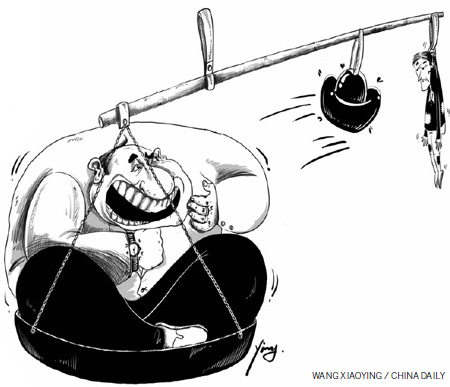
Chinese people are becoming richer, and the wealth gap in China is, as expected, growing. The just concluded Spring Festival holiday saw consumption reach about 400 billion yuan ($60.69 billion), with many rich Chinese travelling abroad to enjoy their holiday and, with some of them, buying luxury goods.
The CLSA Asia-Pacific Markets has even forecast that China will become the top luxury goods' market by 2020. In stark contrast, China's per capita GPD is still about $4,000 (2010 figures), far below advanced countries' average.
Generally speaking, most of the public debate focuses on two types of income disparity: urban-rural disparity and disparity among urban residents. The history of rural-urban income disparity shows that from the early 1990s to 2004 the ratio rose almost steadily to 3.4 times, and has since then remained stable. Another measure of income disparity is Gini coefficient, which for China is now close to 0.5. This means a small percentage of Chinese people hold a high percentage of the country's wealth.
While we cannot deny that the wealth gap is a big problem and a huge challenge for the government, we can think about it in a slightly different way that makes this problem look less dramatic than generally believed.
First of all, most people tend to use per capita GDP as a proxy for income. But this is not the correct approach, because personal income is just one component of GDP and, in China, the gap between the two figures has widened: personal income as a proportion of GDP has fallen from a high of 65 percent in 1990 to 43 percent today.
Take Shanghai, for example. It is often considered China's richest city, where affluent people splurge on various types of entertainment. Its per capita GDP might have been $11,451 in 2009, but its average personal disposable income was only $4,375. That was only 30 percent of its GDP and below the urban average of 70 percent. More interestingly, Shanghai personal disposable income is only double the value of "poorer" provinces like Sichuan. Hence, the real income gap between China's richest and poorest areas is not as wide as often assumed.
Within Shanghai, however, there are large disparities, with the richest quintile of the population earning five times more than the poorest. Though a multiple of five seems high, it is not as bad as it looks because members of the low-income segment still take home about 10,000 yuan a year. These are people doing temporary work such as shop assistants and waiters. On one hand, the quality of their lives is not the best, as they often live in crowded, not very clean houses and with little or no social services provided for; on the other, many of them have their living and food expenses paid by their employers, which means their overall financial condition is not as bad as many people think.
Another oft-discussed issue is that income disparity creates unhappiness and can lead to social unrest. However, an interesting paper by Lu Ming, a professor of economics at Fudan University, shows that income disparity does not necessarily imply a higher level of dissatisfaction and unhappiness.
Lu uses a traffic example to make his point. When we are stuck in a traffic jam in our car, we feel frustrated and impotent, as there is nothing we can do to improve our situation. But when some cars in front of us, no matter how far ahead, no matter how slowly, begin to move forward, we feel a sense of anticipation. There is something we can then look forward to, and even if we are still stuck in exactly the same position, our level of happiness increases, because we know that at some point in time, it will be our turn to move forward. The cars in front that move first, of course, represent people whose income rises first.
| ||||


It will, however, not be wise to narrow the wealth gap by stopping the "cars in front", because only when all cars in front have moved, can we expect the cars behind to proceed - which is to say our income will not rise until that of some others are raised first.
The author is head of China Program at the Global Policy Institute of London Metropolitan University and senior research fellow at Zhejiang University.
| 分享按鈕 |