Economy
TCM supporters push Europe to relax ban
By Fu Jing and Shan Juan (China Daily)
Updated: 2011-05-03 10:49
 |
Large Medium Small |
BRUSSELS / BEIJING - Advocates of Traditional Chinese Medicine (TCM) are working hard to win amendments to a hotly-debated and "problematic" piece of legislation that is likely to stem the flow of TCM products into Europe.
 |
|
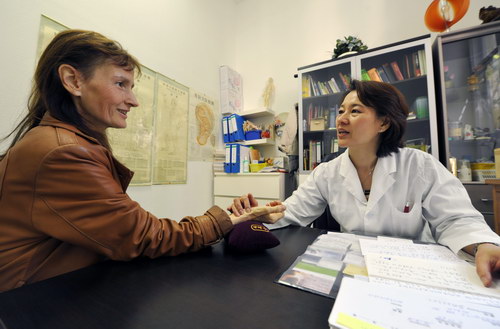
Doctor Dai Beiyan takes the pulse of a German patient during a traditional Chinese treatment session in Berlin on April 21, 2011.?[Photo/Xinhua] |
The legislation, the Traditional Herbal Medicinal Products Directive, was passed by the European Union (EU) in 2004 and came into force on May 1 following a seven-year transitional period.
An industry insider, who asked for anonymity, said the legislation was the result of lobbying by major pharmaceutical companies.
"The multinationals will get bigger market shares if TCM companies fail to pay the high registration fees they now need to enter the EU market," said the source, who is the chair of a TCM college in Europe and who claims to have close relationships with European regulators of medicine.
| ||||


When the transitional period ended on Saturday, no Chinese TCM products had been registered.
The insider claimed several multinationals had paid "a high cost" to the lobbying groups that ensured the legislation was drafted.
Huang Jianyin, deputy secretary-general of the World Federation of Chinese Medicine Societies, said the new rules will ensure there are few if any TCM products on the European market.
"Stores that sold the products in the EU in the past will bear the brunt," he said.
But he emphasized that there was not any anti-China or anti-TCM discrimination behind the new rules because they "apply equally to all traditional herbal medicines".
Huang said there were several reasons why Chinese companies failed to get their products registered.
"Factors including a poor understanding of EU market rules, high registration fees and the complicated registration procedures all contributed to the current plight of TCM in the EU market," Huang explained. "A registration costs a TCM company 3 million yuan ($462,000), which scared them away."
Chris Dhaenens, president of Benefyt, a Netherlands-based foundation that represents and defends the interests of those companies and operators in Europe involved in traditional medicine, said the cost was simply prohibitive.
"For a company with 800 products, the registration fee could equal its whole turnover," he said. "That would be impossible given that the sum only covers the registration of a single product."
Huang suggested that the Chinese government should support Chinese companies seeking EU registration both financially and by providing information.
With a history of more than 2,000 years, TCM did not enter the EU market on a significant scale until the mid-1990s. Products are mainly sold to European customers as food supplements and not medication.
Several Chinese herbal companies attempted to get their products registered but either failed or backed out of the process because of the expense or difficulty.
Thomas Brendler, CEO of PlantaPhile Ltd, a Europe-based consultancy company, said the purpose of the new legislation was to ensure consumers are not exposed to unsafe products.
Dhaenens said regulators in most EU member states will likely step up supervision now that the new rules take effect.
"This will have an impact on European importers of TCM," he said.
Dhaenens said his organization is working with others to try to get the legislation amended.
Both Dhaenens and Wilfried Legein, president of the Belgian College of Traditional Chinese Medicine, agreed that there are still opportunities to amend the directive, if Chinese medicine regulators and industry federations work with their European colleagues.
"I am not saying the directive is 100 percent bad but if we work together and apply pressure, there is the chance of getting it amended," said Legein.
In 2010, the value of TCM exports from China reached nearly $2 billion.
Xinhua contributed to this story.
| 分享按鈕 |