Economy
EU carbon rule may hurt China's aviation sector
By Li Jing (China Daily)
Updated: 2011-05-18 10:26
 |
Large Medium Small |
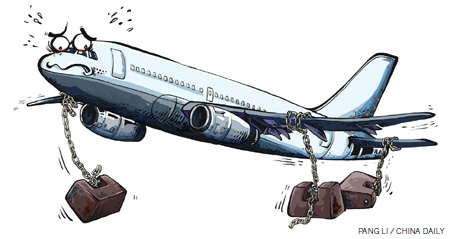 |
EU program will drastically increase operating costs for airlines, reports Li Jing in Beijing.
Watch out, frequent travelers between China and Europe. You may have to pay more for flights starting next year to offset your carbon footprint.
The European Union has set Jan 1 as the starting date for all flights, incoming and departing from the continent, to meet emission limits or pay penalties for breaking them.
The four Chinese airlines - Air China, China Eastern Airlines, China Southern Airlines and HNA Group - that operate flights between China and Europe have been asked to abide by the rule.
|
||||


This is the first time that China's companies have been assigned the same obligations to deal with carbon emissions as their competitors in industrialized nations. China is still a developing nation, but experts say that as one of the world's top carbon emitters it should prepare for similar challenges in the future.
Both Chinese airlines and the country's aviation regulator have voiced strong opposition to EU's cap-and-trade approach to reining in the aviation industry's carbon emissions. They say the program fails to reflect the differences in responsibilities for developing and developed countries in the fight against climate change, where only the rich groups are obliged to cut their carbon emissions.
"The EU needs to take into account the different development status of countries," Li Jiaxiang, head of the Civil Aviation Administration of China, said on May 10 in Beijing.
Days before the remark, China Air Transport Association (CATA) issued a more blunt statement declaring the Chinese industry does not recognize a unilateral mechanism that "violates international aviation convention and intrudes into China's national sovereignty".
It said the association may suggest that the Chinese government take harsher countermeasures against flights in and out of China operated by airlines from EU countries.
The statement also said the EU plan is defective because it relies on indirect cap-and-trade measures that "cannot produce any direct, practical effect on energy saving and emission reduction".
Billions to pay
The EU approved a proposal in 2008 to include the aviation industry in its Emission Trading Scheme (ETS) after emissions from the sector had doubled since 1990. Such emissions account for around 3 percent of the EU's total carbon footprint.
Starting next year, airlines landing in Europe will be forced to buy carbon credits to cover each ton of carbon emission they emit in excess of the cap. The EU listed 2,000 airlines globally under its plan, with 33 of them from China's mainland, Hong Kong and Macao.
EU gives exemptions for airlines whose annual carbon emissions are below 10,000 tons. That roughly equals the carbon footprint of 22 single trips between Shanghai and Brussels with a Boeing 777 aircraft.
According to the industry's calculation, China's airlines would have to pay 743 million yuan ($114 million) in 2012 alone. If the airlines added one flight between China and Europe each week, that would add 15 million yuan to the cost. The annual bill could reach more than 3 billion yuan by 2020.
Analysts say this would dramatically increase the airlines' operation costs and hinder further development of China's burgeoning aviation industry. The timing is problematic because major Chinese airlines are eyeing stronger expansion in overseas routes and face increased competition domestically from the spreading network of high-speed railways.
European countries are among the top destinations for Chinese travelers. For instance, Air China recently added flights to Dusseldorf, Germany, and to Milan and is planning to open new routes to Europe, according to Kong Dong, the airline's chairman.
The increased cost would likely be passed on to passengers.
"At this stage I'd say (Chinese airlines) are not going to take the step (to join the plan) . . . as we don't recognize ETS," said Chai Haibo, CATA's deputy secretary-general. "But if finally the airlines are forced to pay for the carbon credits, I'm afraid that the travelers will have to pay more for their tickets."
Chai would not estimate the size of the fare increase, but an earlier report by China Central Television put it at 200 to 300 yuan for each single trip between China and European countries.
| 分享按鈕 |