Economy
Fears over hot money from QFLP aired
By Cai Xiao (China Daily)
Updated: 2011-06-09 16:24
 |
Large Medium Small |
|
 |
|
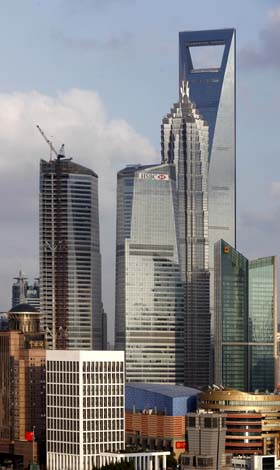
Skyscrapers in the Lujiazui financial district in Shanghai, the fist city to release a qualified foreign limited partner policy. [Photo/Agencies] |
BEIJING - Concerns about the inflow of so-called hot money are being raised about Shanghai's pilot scheme allowing qualified foreign institutions to make private equity (PE) investment in China.
The move, which marked an important step in the liberalization of China's capital markets, enables certain overseas investors to convert foreign currencies into yuan for private equity investment in China.
The scheme, known as Qualified Foreign Limited Partner (QFLP), is modeled on China's Qualified Foreign Institutional Investor program, which allows foreign investors to buy Chinese stocks and bonds.
The fears are that without adequate controls, it will pave the way for speculative hot money to easily move in and out of China, causing potential economic instability. Hot money refers to the flow of funds or capital from one country to another in order to earn a short-term profit on interest rate differences and/or anticipated exchange rate shifts. These speculative capital flows can move very quickly in and out of markets.
|
||||


"It would also help accelerate China's economic restructuring and strengthen Shanghai's role as an international financial center."
China has relaxed rules to allow foreign private equity firms such as TPG and Carlyle to launch yuan funds as the government sought to channel more savings into the private sector to sustain growth.
The Blackstone Group LP, The Carlyle Group and DT Capital Partners Co were the first companies to win licenses to operate under the scheme, followed by Texas Pacific Group and Guosheng CLSA Industrial Management Co Ltd.
Antony Leung, chairman of Blackstone Greater China, said: "It's a great measure for cities to develop international finance."
China's foreign exchange regulator granted Shanghai a $3 billion initial quota for the program, sources with knowledge of the situation told Reuters in November. Carlyle and Blackstone have so far received quotas of $100 million each.
Beijing is also stepping up plans to implement the policy. According to 21st Century Business Herald, JP Morgan Chase & Co is cooperating with the Beijing municipal government to set up a yuan-denominated fund of $2 billion, part of which will be raised though the QFLP channel.
Chongqing and Tianjin have also been attempting to establish themselves as financial centers by adopting policies that are attractive to investors, including QFLP. However, local governments have been instructed to first negotiate with national departments before implementing the policy.
In 2009, the State Administration of Foreign Exchange released a rule that unless otherwise provided, foreign enterprise yuan funds after settlement are not allowed to buy equity investment in China, as a way of preventing hot money from flowing in.
According to a report released by the Institute of International Finance on June 1, private capital inflows to emerging economies in 2011 are expected to reach $1.04 trillion. More than $250 billion of that is expected to arrive in China. The Chinese capital account is more closed than most other large emerging economies and the exchange rate is more tightly managed.
"The policy of QFLP may bring in some hot money, but the trial amount of money is very small, only totaling several hundred million dollars," Leung said.
"QFLP is performing as required, and we are waiting for more detailed operating guidance," Leung said. He added that setting up large yuan-denominated funds in China is not easy because the Chinese private equity market is still in its infancy and there are not many strong domestic limited partners.
| 分享按鈕 |