Economy
Small firms, big problems as costs rise
By Chen Jia (China Daily)
Updated: 2011-06-29 11:26
 |
Large Medium Small |
|
 |
|
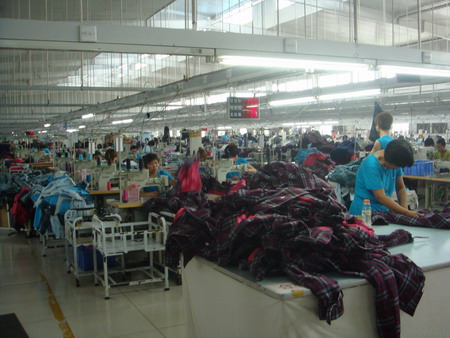
A garment factory in Baigou, Hebei province. China's small enterprises are facing increasing pressure from rising costs and some are closing their doors as a result. [Photo / China Daily] |
Rising prices have not only been hitting consumers, but also small businesses, Chen Jia reports from the towns of Baigou and Rongcheng in Hebei province.
A decline in freight orders, which started in mid-May, has caused a number of problems for Zhang Yan, the owner of a delivery company .
Zhang owns 30 vans that mainly transport goods manufactured in Baigou town, Hebei province, a major production center for the luggage industry, 102 kilometers south of Beijing. The decline in orders convinced Zhang that a downturn in business was inevitable as bag makers were facing a contraction.
"Two of my clients shut down their businesses last month and some of the others have reduced production because of squeezed profit margins," said Zhang.
|
||||


The rapid rise in labor costs and the soaring price of raw materials, together with the increasing cost of borrowing, has left small and medium-sized businesses (SMEs) there facing a dilemma.
In June, inflation in China showed no signs of abating. The consumer price index, the main gauge of inflation, rose to 5.5 percent in May, and when the figures for June are released in the middle of next month, they're expected to confirm another increase.
Moreover, the Producer Price Index, which reflects changes in the prices of raw materials and other costs, came in at 6.8 percent in May, down from 7.3 percent in March, but still much higher than in September, when it was 4.3 percent.
Meanwhile, the authorities have cracked down on lending and the money supply to combat inflation, a move that has further increased the pressure on China's capital-thirsty small businesses. To make ends meet, some businesses have even been forced to use underground financing sources, which charge exorbitant interest rates. Moreover, wages have been rising continually in recent years, adding to corporate costs.
Along the main street of Baigou where many small workshops are situated, a number of the factory gates have been closed for some time.
"The price of leather increased about 20 percent and salaries have jumped by about 30 percent from the beginning of this year, but we didn't raise retail prices," Liu Hui, the owner of a local bag workshop, told China Daily. More local factories have begun using cheaper artificial leather as a raw material, said Liu.
Liu said: "I cannot say that production will drop this year, but profit will surely decrease. I hope the hard times won't last long."
The rising price of raw materials and limited access to regular bank loans have also encroached upon the only competitive edge possessed by these small-scale enterprises - low costs and retail prices.
Baigou is not the only place under threat. SMEs in Rongcheng, a county in Hebei province where 70 percent of the local GDP comes from the garment industry, are also facing similar difficulties.
Zhou Yancheng, the 43-year-old general manager at Aosen Clothing Ltd Co, has been running his business in the county for more than 10 years. The company's products are mainly exported to markets in Europe and South America.
"As far as I know, many of our previous clients have turned to Southeast Asia, where garment factories can offer lower prices," said Zhou, adding that orders from overseas decreased by about 30 percent in the first five months of this year.
"Now it is the most difficult time for me. It is very hard to borrow money from banks, while overseas orders were even lower than during the global financial crisis in 2008," Zhou said, with a sigh.
In one of his factories, 12 noisy assembly lines were running. "Since the beginning of this year, I have raised average annual salaries by 25 percent, from 24,000 yuan ($3,707) to 30,000 yuan," said Zhou. "It has become more difficult to hire people recently, and the cheap labor that once existed is no longer there."
Gu Shengzu, an economist and senior national legislator, said that companies hiring rural migrant workers have raised salaries by at least 20 percent nationwide since the beginning of the year.
| 分享按鈕 |