Use of chemicals 'threaten grain output'
Updated: 2011-07-18 06:59
By Jin Zhu (China Daily)
|
|||||||||||


BEIJING - The heavy use of agrochemicals has led to a severe deterioration of arable soil and poses a serious threat to domestic grain output.
The situation has led to some leading ecologists calling on authorities to reduce the use of pesticides and chemical fertilizers.
Despite floods and droughts, China's grain production hit 546.4 million tons in 2010, the seventh consecutive year of growing output.
"But this (grain growth) will not last long if the government fails to take timely and effective measures, as the soil is already too poor to support high-yield crops," Jiang Gaoming, a leading researcher at the Chinese Academy of Sciences, said.
The average level of organic matter in soil, which is crucial in determining crop output, is now 1 to 5 percent for northeast China's arable land, compared with 8 to 10 percent in the 1950s, according to figures from the academy's institute of soil sciences.
Statistics from the Chinese Academy of Agricultural Sciences (CAAS) also show that more than one-third of land now has harder and thinner tillage layers, which mean crops cannot be planted as deep.
Jiang said the problems have been caused by the massive overuse of chemical fertilizers over the past 30 years, following China's pledge to realize grain self-sufficiency.
Annual grain output increased from 320.56 million tons in 1980 to 546.4 million tons in 2010, according to the National Bureau of Statistics.
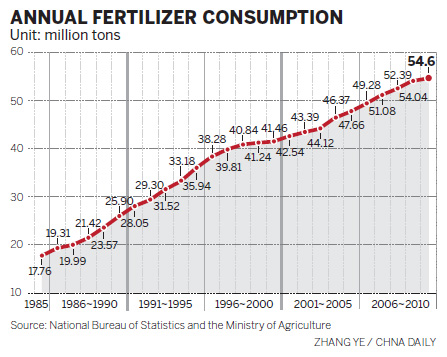
However, since 2007 China has been the world's largest consumer of chemical fertilizers, using more than 50 million tons every year, four times the amount in the 1980s.
"More chemical fertilizer, more grain output - that's been a common misunderstanding among government officials and farmers for dozens of years. Crops were always fertilized, regardless of cost, to guarantee high production," Jiang said.
Experts also argue that an increase in plant disease and the deterioration of the environment have been triggered, partly, by years of chemical fertilizer use.
"Farmers usually only care about crop output and income. They seldom consider the soil damage and potential risks to human health from overusing fertilizers," Li Shilin, director of the agricultural technical station in Anhui province's Fengtai county, said.
China uses 1.3 million tons of pesticides annually, with usage per unit area 2.5 times the global average, Zhang Weili, a CAAS professor on soil and fertilizer, told China Daily, citing official figures.
Also, the country's surface water pollution is grave while its seven major rivers and coastal waters are also polluted, a report by the Ministry of Environmental Protection said in June.
Of the 26 lakes and reservoirs under monitoring, 42.3 percent are "eutrophicated", a process that can lead to a proliferation of plant life caused by excessive levels of phosphorous and nitrogen, the report adds.
"China can no longer boost grain production by relying on agrochemicals," Zhang said.
Together with her colleagues at the CAAS, Zhang conducted a field investigation on the effects of agrochemicals on soil fertility across the country over the past 10 years.
"More cultivated land will face risks of greater yield decreases in the next few years since the soil is too fragile to withstand natural disasters, which will become more severe and longer due to climate change," she said.
Jiang, from the Academy of Sciences, highlighted the importance of government support.
"More subsidies are needed to support intensive cultivation, a traditional way to protect soil fertility. At present, almost no farmers are willing to do so because of higher costs in terms of time and money," he said.
Lu Bu, another CAAS professor, said farmers needed practical help.
"The government should encourage companies to help local farmers with intensive cultivation, such as providing advanced equipment that ordinary farmers cannot afford."