WTO ruling not end of road for China
Updated: 2011-07-20 11:37
By Mei Xinyu (China Daily)
|
|||||||||||


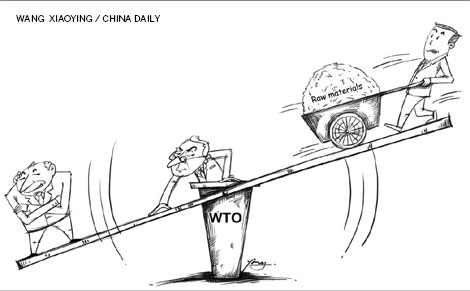
The World Trade Organization (WTO) released a report recently that says China's export restrictions on nine raw materials - alumina, fluorite, manganese, metallic silicon, carborundum, yellow phosphorus, zinc, coke and magnesium - are inconsistent with WTO regulations. This indicates that China has lost the first round of the battle with the United States and the European Union on export restrictions on raw materials.
 |
If China does not appeal within 60 days of its release, the report would be adopted as arbitration, according to WTO rules. China is certain to appeal, but it has to provide convincing evidence to challenge the WTO contention to get the report partly revised or overthrown.
But China also needs to be prepared for a loss, because the report reflects the views of many WTO experts. Besides, in its biennial report, released last year, evaluating China's trade policy, the WTO criticized China for its export restriction policy on raw materials.
The WTO's unfair and subjective criticism of China's trade policy, however, exposes the insufficient representation of developing countries in the WTO, International Monetary Fund and other international economic organizations, especially because it is difficult for such organizations to understand developing nations' problems.
Instead of targeting China for its export restrictions, the WTO should criticize the three iron ore companies that have been manipulating the market, as well as its own defects. But any change in the WTO will be a slow process.
China now needs to levy higher taxes on the high energy-consuming and high-polluting sectors to reduce the output of natural resources, so that even if it has to loosen its export restrictions on raw materials, the quantity exported would not increase dramatically because of weaker productivity.
Export restrictions, however, remain the most effective way for China to reduce energy consumption and better protect the environment, for such raw materials are mostly in great demand abroad. The rest of the world has to realize that China cannot go on sacrificing its environment for the benefit of other countries.
If China were to impose a direct tax on the output of raw materials, it would require relatively a more complicated monitoring system to impose tax on production and domestic sales. This will increase taxation costs - and should be the last resort to protect the environment if China loses the case.
Yet we cannot be pessimistic because American and European interest groups at times change their minds fast.
The West accuses China of imposing export restrictions on raw materials when supply is falling in the primary product market. If the bullish market ends, it is highly likely that the West would ask China to impose export restrictions to protect Western industries and sales.
There is precedence for that. The EU is now criticizing China for imposing export restrictions on resources such as coal and coke, but several years ago it criticized China for exactly the opposite reason: unrestricted exports of coke. It even threatened to level official dumping charges against China.
This bullish market for primary products has lasted an unprecedented nine years. But the possibility of the bull run's end is increasing with each passing day, as indicated by the market fluctuations since May.
More importantly, China has to fight to get the unequal clauses in the Protocol on the Accession of China to the WTO revised. The failure to do so until now has cost China heavy.
Last year's WTO evaluation report on China's trade policy said the main reason why the country is implementing export restrictions on raw materials is to meet its domestic demand, which also constitutes hidden subsidies for domestic manufacturing. Even if that is true, it is in accordance with the fundamental rules of the WTO. Article 20 on "General Exceptions" of the General Agreement on Tariffs and Trade (GATT), the forerunner of the WTO, says that a contracting party can adopt "restrictions on exports of domestic materials necessary to ensure essential quantities of such materials to a domestic processing industry". The WTO report, however, insists that China cannot quote the article according to the clauses in the Protocol.
But Protocol Article 11 on "Taxes and Charges Levied on Imports and Exports" says "China shall eliminate all taxes and charges applied to exports unless specifically provided for in Annex 6 of this Protocol or applied in conformity with the provisions of Article VIII of the GATT 1994". And Protocol Annex 6 on "Products Subject to Export Duty" lists 84 kinds of products on which export duty can be levied, and they include products now under dispute such as yellow phosphorus and zinc.
Since the annex stipulates the highest level of export duty for these products, China has said that it will not increase the existing rates, except under exceptional circumstances. If such circumstances occur, China will consult affected members before increasing the tariffs and try to find a mutually acceptable solution.
But if China loses this case, it should consider moving the WTO against the US or the EU because the two economies' export restrictions are even stricter.
The author is a scholar with the Chinese Academy of International Trade and Economic Cooperation.