China's inflation may have peaked
Updated: 2011-08-22 09:11
(Xinhua)
|
|||||||||||


| ?
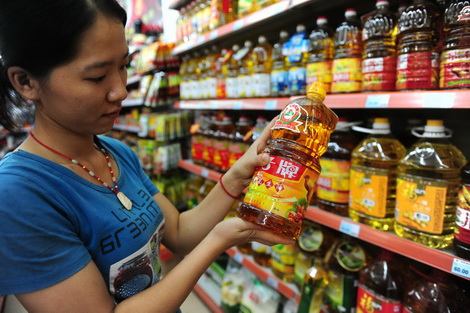 A citizen chooses cooking oil in a supermarket in Qionghai, south China's Hainan Province, Aug 3, 2011. The price of pure peanut oil rose 18.8 percent in August compared to the same period in last year. The peanut oil price on Aug 8, 2011 is 2.8 percent higher than that of June 20, 2011.[Photo/Xinhua] |
SINGAPORE-- The consumer price Index (CPI) in China has most probably peaked in July at 6.5 percent, an economist from the Development Research Center of the State Council said here on Saturday.
Another economist from Singapore also said that the CPI in China have in fact started to stabilize, adding that the inflation could be pushed down faster than expected by falling pork price in six to 12 months, just as it has been pushed up fast earlier.
Nevertheless, the inflation pressure is expected to stay for some time to come, and economists said China should stick to its policy of monetary tightening.
Food demand?and supply
Speaking at a Forum on China's Macroeconomic Conditions and Macro Policies in Singapore, Zhang Liqun, an economist from the Development Research Center, said he expected the inflation pressure resulting from surging food prices to start easing as supply increases.
Grain and rice output in China has been growing steadily in recent eight years and the production capacity of vegetables has also increased as the government has put in place incentive programs.
"Generally speaking the food supply situation has been improving, whereas the demand is basically stable," he said.
"(The 6.5 percent of CPI) in July should be a peak," he said.
China has been trying to tame the inflation recently. Nevertheless, the CPI hit 6.4 percent in June and 6.5 percent in July, respectively, due to excessive liquidity and surging food prices.
Pork?price to ease in Q3
Zhang also said that the price of pork is expected to stabilize in September and October as an equilibrium is achieved in its supply and demand.
The pork price started to surge in the second half of 2010, encouraging farmers to increase their stock. The number of pigs in stock has been increasing starting from February, he said.
Tan Kong Yam, director of Asia Competitiveness Institute, the National University of Singapore, said pork prices accounted for as much as 3 percent of the total basket for the CPI in China.
"A surge of 50 to 60 percent in pork price would mean a contribution of 1.7 percentage points to the consumer price index, " he said.
The CPI in China would be 4.8 percent if the price of pork is excluded, meaning that the CPI has already started to ease, Tan said.
"I think the fall of CPI may be sharper than expected when the pork price falls in six to 12 months," he said.
Inflation to stay
High inflation is expected to stay for some time to come, most probably between 4 percent and 5.4 percent in 2011 and 2012, a team of economists from the Xiamen University in China and the National University of Singapore said in their latest forecasts on the China's economy released on Saturday in Singapore.
Chen Kang, professor of economics from the Lee Kuan Yew School of Public Policy, National University of Singapore, said the recovery in the United States have been weaker than estimated, as reflected in the downward revision of US economic growth figures in late July.
This also explained the sharp correction recently in the stock markets, he said.
Nevertheless, economists at the forum said China should stick to its policy of monetary tightening.
There is no need for China to put in place excessive stimuli aimed at faster economic growths, said Li Wenpu, an economist from Xiamen University.
Zhang Shuguang, an economist from China-based Unirule Institute of Economics, said China has inflation because its economic growths in recent years have been much faster than the potential growth, creating excessive demand.
Zhang Xiaojing, an economist from the Chinese Academy of Social Sciences, said he expected China to generally stick to its policy of raising interest rates, but the frequency may be subject to adjustments.